


2013, Irene Agbontaen founded TTYA ( Taller Than Your Average) after experiencing a problem the fashion industry had largely overlooked: finding clothes that actually worked for tall women. What began as a personal frustration grew into a brand stocked by some of the world’s biggest retailers, before evolving into something much bigger across fashion, music and culture.
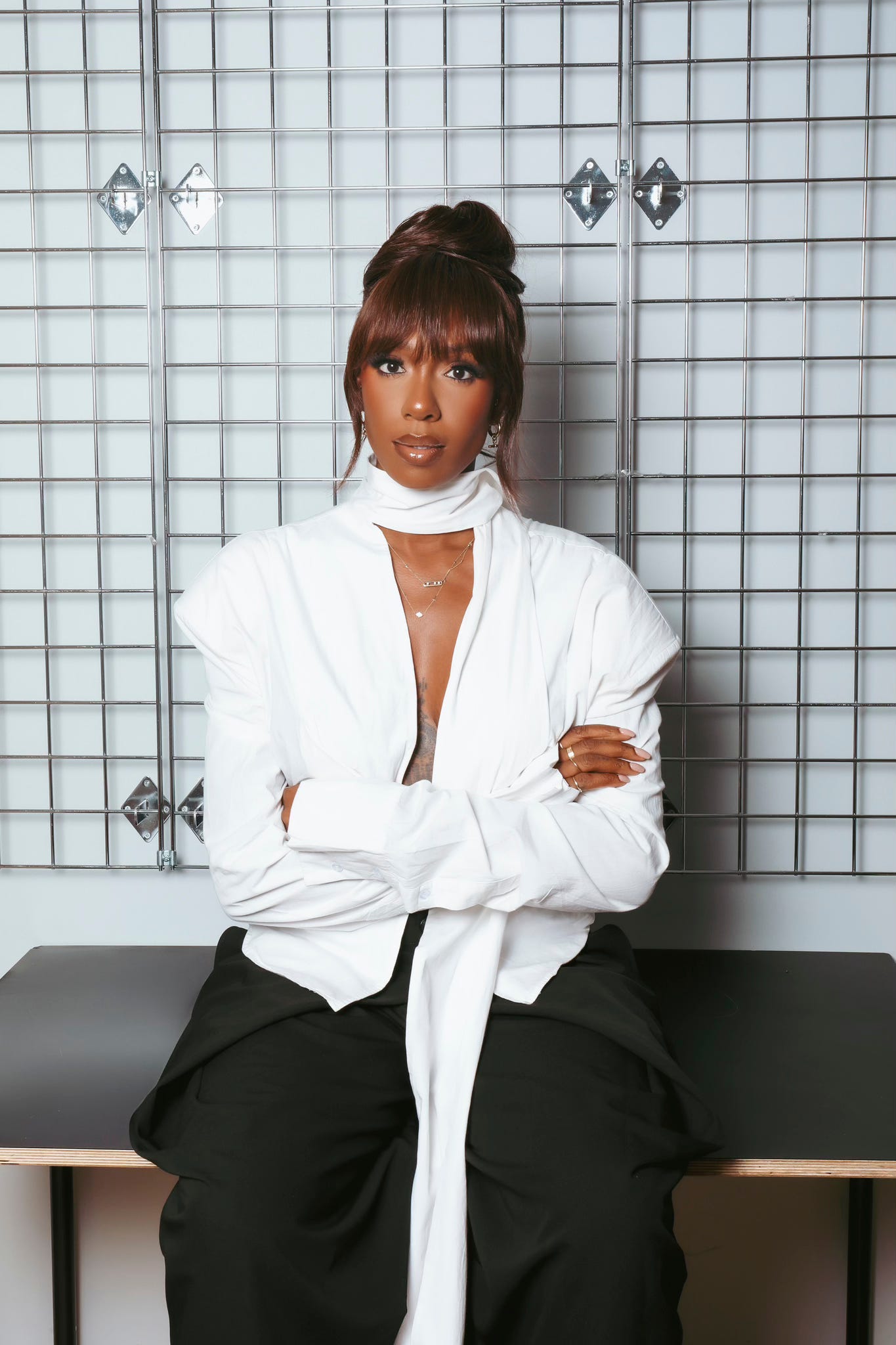
Now, more than a decade later, Irene is bringing TTYA back as TTYA [LAB], a new chapter centred around experimentation, community and designing with tall women in mind from the beginning. Shot by Gabriel Moses, the relaunch marks a return to the original idea, but with everything Irene has learned from years spent building brands, platforms and cultural spaces.
From working with artists including Tyla, Central Cee and Burna Boy to hosting conversations with some of culture’s most recognisable voices through TTYA Talks, Irene has built a career around spotting what’s missing — and bringing the right people together to create something new.
Irene Agbontaen caught up with GUAP to talk TTYA [LAB], building across fashion, music and culture, and what it means to create spaces where people no longer have to make themselves smaller to fit in.
TTYA started from a very personal frustration with fashion: the lack of clothes that worked for tall women. What does it feel like to return to that original problem more than a decade later, but with everything you’ve learned since?
It feels both full circle and completely new. When I first started TTYA, I was solving a problem that I experienced personally. I’m 5’11”, I loved fashion, and I was frustrated that the clothes available to me rarely reflected how I wanted to look or feel. At the time, I was working instinctively. I knew the problem existed because I was living it, and I knew other women were living it too.
More than a decade later, the problem hasn’t disappeared, but I’ve changed. I understand business, brand, culture and consumer behaviour in a much deeper way. Most importantly, I have spent years listening to our community. I now know this isn’t simply about making a trouser longer. It’s about proportion, fit, confidence and giving women the freedom to participate in fashion without constantly having to compromise.
Returning to TTYA with that knowledge feels powerful. I’m not starting again. I’m building from everything the first chapter taught me.
Why is now the right moment to relaunch TTYA as TTYA [LAB]? What changed for you, and what changed about the world around the brand?
The first time I built TTYA, I was trying to prove that tall women were a customer worth paying attention to. Today, the conversation has moved forward, but the product offering still hasn’t moved far enough with it.
Consumers are much more informed now. Young women understand branding, construction, quality and representation. They can immediately tell when a brand has genuinely considered them and when inclusion has been added at the end as a marketing exercise. They don’t just want to be visible in a campaign. They want the product itself to work.
What changed for me was that I became much clearer about what TTYA could be. I didn’t want to return simply because there was nostalgia around the original brand. I wanted to come back with a stronger proposition, the right infrastructure and a clear reason to exist.
TTYA [LAB] is wardrobe systems for tall women. It is designed around how women really dress: rotating, layering and repeating pieces across different parts of their lives. This felt like the right moment because the community was ready, I was ready, and I finally had the experience to build the business at the scale of the original idea.
The word “LAB” suggests experimentation, collaboration and research. What does TTYA [LAB] represent to you that TTYA didn’t?
The original TTYA was about identifying the problem and creating visibility around it. TTYA [LAB] is about going deeper into the solution.
“LAB” gives us permission to research, test, listen and keep improving. Tall women aren’t one body type, so it would be dishonest to pretend there is one simple answer to fit. We want to learn from the women wearing the product and use their experiences to develop better proportions, better wardrobe systems and, over time, better technology.
It also reflects the way I naturally work. I like bringing different disciplines and perspectives into one space: fashion, culture, technology, sport, community and consumer insight. The LAB is where those ideas can meet.
For me, it signals that this brand will never consider the work finished. We’re not presenting ourselves as having solved everything with one collection. We are building an ongoing study into how tall women live, dress and want to feel.
You’ve described yourself as someone who spots gaps rather than necessarily seeing yourself as a traditional designer. Has that distinction become clearer to you as your career has developed?
Definitely. When I was younger, I thought that to build a fashion brand I needed to fit the traditional image of a designer. Over time, I’ve realised that my strength is seeing what is missing, understanding why it matters and bringing the right people together to create a solution.
I’m deeply involved in the product and the creative direction, but I don’t need to pretend that I sit alone sketching every garment. Building something meaningful is rarely one person’s work. My role is to hold the vision, understand the customer and make sure every decision connects back to the problem we are trying to solve.
I think that distinction is particularly important for young people to hear. You don’t always have to fit an existing job title to contribute something valuable. Sometimes your skill is connecting dots that other people haven’t connected yet. That is a creative discipline in itself, and learning to trust that has made me a much stronger founder.
You chose Gabriel Moses to shoot the campaign. What was it about his visual language that felt right for this new chapter of TTYA?
Gabriel has an ability to make images feel timeless, emotional and culturally specific without overexplaining them. There is a real depth to his work. He photographs people with strength and sensitivity, and the result never feels like a trend or a moment that will disappear in six months.
It was also important to me that this new chapter was documented through the perspective of two British-born Nigerians. There is a shared cultural understanding between us, but I didn’t want the campaign to feel literal or expected. I wanted the clothes and the women wearing them to feel powerful, considered and monumental.
TTYA [LAB] is functional, but it also carries emotion. For tall women, clothing can be connected to years of shrinking yourself, feeling exposed or being told that your body is the problem. Gabriel’s visual language gave the collection the weight it deserved. He didn’t just photograph clothes. He captured presence.
You’ve worked across fashion, music and culture, from building TTYA to working alongside artists like Tyla, Central Cee and Burna Boy. What connects all of those worlds for you?
For me, the connection is identity. Fashion, music and culture are all ways people communicate who they are before they have even said anything.
Working with artists has taught me a lot about world-building. The most compelling artists don’t only release music. They create a visual language, a feeling and a community that people can recognise and belong to. I think about brands in a very similar way.
Across everything I do, I’m interested in how an idea moves through culture and how you protect what makes it special while helping it reach more people. Whether I’m working with an artist or building TTYA [LAB], I’m always asking: What is the truth at the centre of this? Who is it for? How do we make it bigger without diluting it?
The industries may look different from the outside, but the work is often the same. It is about understanding people, building trust and turning a clear point of view into something others can feel.
You’ve become known for creating rooms and bringing people together. What makes a room feel culturally significant to you, and how do you create that feeling?
A culturally significant room isn’t necessarily the room with the most famous people in it. It is a room where the mix of people creates a conversation that couldn’t have happened anywhere else.
I think carefully about energy. Who is established? Who is emerging? Who has influence that might not be visible through follower numbers? Who has supported the journey quietly? I want someone at the beginning of their career to feel as considered as the person everybody already knows.
The TTYA [LAB] launch reflected that. It brought together women from fashion, music, sport, media and the TTYA community, including people who had supported the brand for years. Not everyone in the room was tall, because Taller Than Your Average has always represented more than physical height. It is a mindset. It is about refusing to make yourself smaller to fit spaces that weren’t designed with you in mind.
The most meaningful rooms create connection beyond the event itself. People leave having met someone, discovered an idea or felt part of something bigger.
Do you think the industry has genuinely become better at spotting talent and communities it previously overlooked, or has it simply become better at marketing to them?
I think both things are true. There is more visibility and access than there was when I started, and we shouldn’t dismiss that progress. Social media has allowed talent and communities to build their own audiences rather than waiting for an institution to validate them.
But visibility is not the same as investment, ownership or power. The industry has become very good at recognising the cultural value of overlooked communities, but it is still inconsistent when it comes to funding their businesses, supporting them beyond a trend cycle or giving them decision-making power.
You can put someone in a campaign and still fail to change the system behind that campaign. You can speak to a community in your marketing while producing nothing that genuinely meets its needs.
The next stage has to be about infrastructure. Who owns the idea? Who receives the investment? Who is in the room when long-term decisions are made? Representation matters, but without opportunity and ownership, it can remain surface-level.
You’ve spent a lot of your career identifying what isn’t there yet. What is one gap in culture right now that you think nobody is paying enough attention to?
I don’t think we pay enough attention to what happens after visibility.
We are very good at discovering people, celebrating a first and creating a moment around someone. We are less effective at building the long-term infrastructure that allows that person, business or community to grow after the attention moves elsewhere. There is often a huge gap between being seen and being properly supported.
This is particularly true for women. Women drive enormous amounts of culture and consumer behaviour, but they are still underfunded as founders, underrepresented in decision-making roles and frequently expected to turn influence into sustainable businesses without the same access to capital or networks.
I’m interested in what comes after the announcement, the viral moment or the feature. Who is helping women build something they can own? Who is supporting the less glamorous middle stage, when an idea needs systems, investment and patience? That is where a lot of culturally important ideas are lost.
If the original TTYA was about solving a problem you personally experienced, what problem is TTYA [LAB] trying to solve now, and what are you hoping to build towards with it?
TTYA [LAB] is solving the problem of tall women still being treated as an adjustment to the standard customer rather than a customer worthy of her own design thinking.
The issue isn’t simply that sleeves or trousers are too short. It is that most wardrobes were never considered as complete systems for our proportions. Tall women are often asked to shop reactively: find the one pair of trousers that is long enough, size up to gain extra length or accept that a garment will sit differently from how it was intended.
We want to move beyond isolated “tall” pieces and build a wardrobe that works together. Pieces that rotate, layer and repeat. Clothes that understand proportion while still feeling relevant, elevated and culturally connected.
Long term, I want TTYA [LAB] to become the global authority on designing for height. That means product, community, research, technology and eventually a much broader ecosystem. I want the next generation of tall girls to grow up believing that clothes should adapt to their bodies, not that their bodies need to adapt to the clothes.