




“Woah, please don’t make me
Sit down
’Cause I just got to Heaven
Sit down
Gonna walk around
Sit down, servant, and rest a while, sit down”
The words vibrate through internal speakers. But they are singing to me. For I am standing amongst the voices of ancestors, whose prayers are answered through my existence.
The artwork in front of me is a glazed wood staircase that commands the centre of the gallery space. Two clay vessels rest on each wooden step. This moment feels similar to kneeling in church, surrounded by the hymns of a choir. The song playing is a collection of sounds from the True Blue Plantation and its descendants, “Sit Down Servant”, performed at a 2022 funeral service.
Their voices, now immortalised, dance around the walls of Artspace, Woolloomooloo, carrying the weight of generations through an internal speaker.
A worker nearby shares a quiet reflection, acknowledging the transformative power of the artwork: “It’s amazing how the clay of all the ashes of the people that have passed away, which are used in her piece, have now been turned into a vessel holding her ancestors”.
For in this space, art becomes more than mere expression. It becomes a witness to the complexities of history, a tangible manifestation of the prayers of all those who came before.
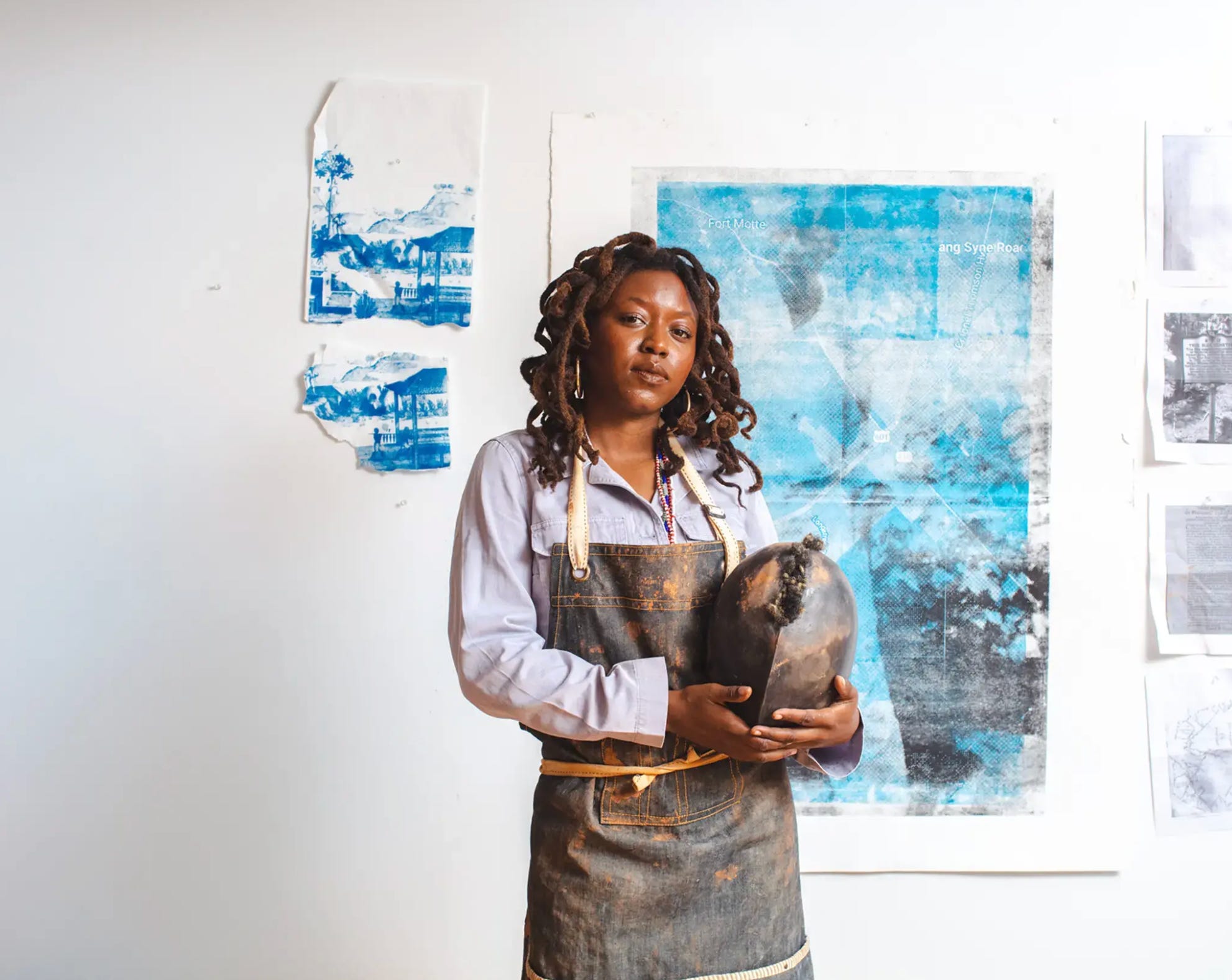
Adebunmi Gbadebo, born in 1992 in Livingston, New Jersey, is a visual artist known for her sculptures, paintings, prints, and paper creations, all crafted from human hair sourced from individuals of the African diaspora. Rejecting traditional artistic mediums, Gbadebo embraces hair as a means to centre her people and their histories within her art.
Her work has been showcased at the 24th Biennale of Sydney, which brings together approximately 96 artists and collectives from across more than 50 countries and territories.
For Gbadebo, the process of curating her art installation of the two vessels, “Sam 2023” and “Adam 2023”, and the staircase they are placed on, is deeply personal and special.
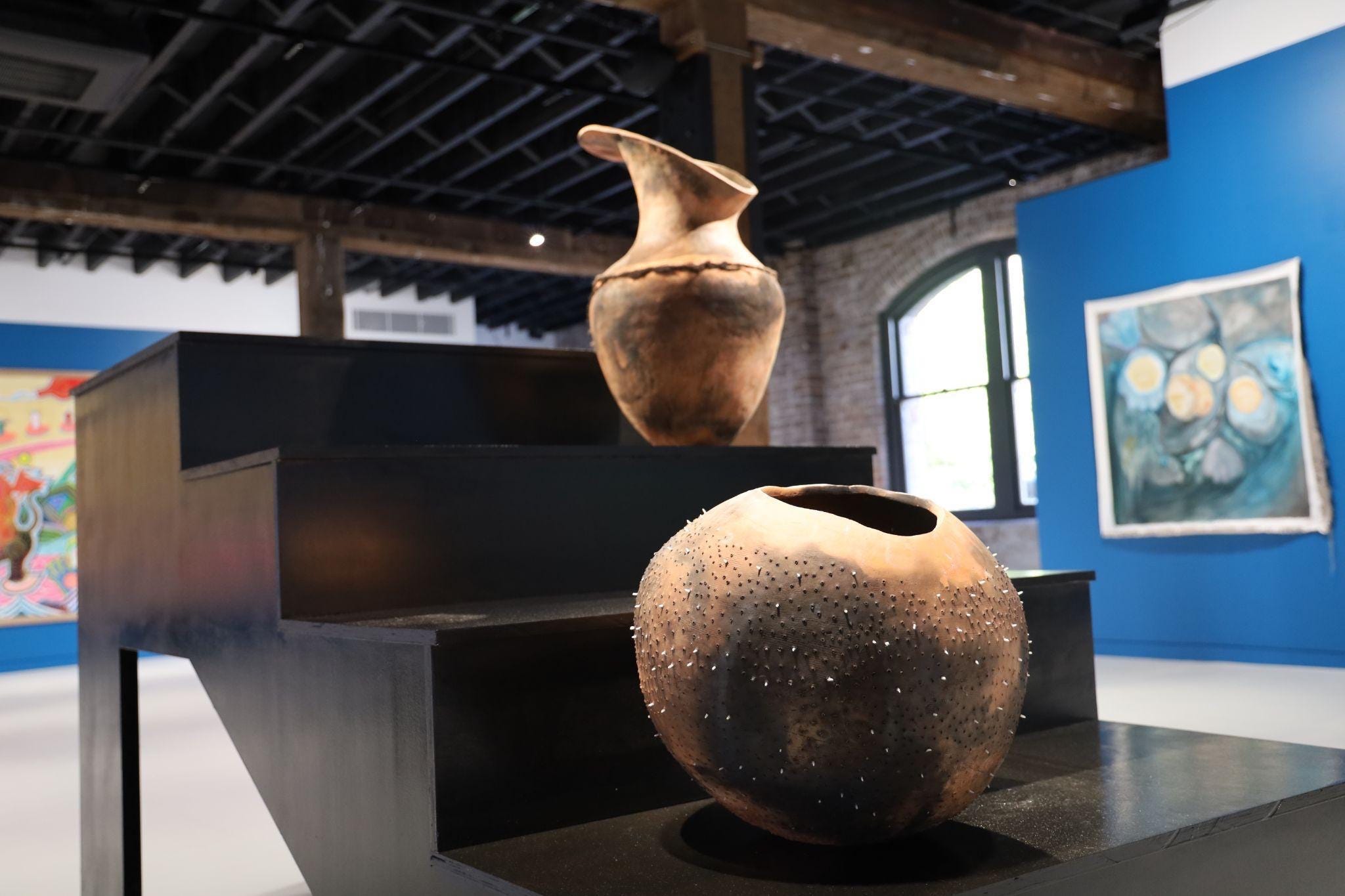
(Sam 2023 on the top step and Adam 2023 on the lower step. Photo taken by Danielle Osifo.)
“Originally, I wanted the stairs to be made by my cousin Benny. My cousin Benny is a descendant of True Blue Plantation. He’s the family member who is responsible for literally building bridges over waterways that are giving us access to the burial grounds. He’s also the relative who has built a lot of staircases. A lot of these burial grounds that my enslaved ancestors are buried on are on these hills, and a lot of the descendants are older and elderly people. It’s quite difficult for them to access the burial ground. So Benny has built staircases from the road to the burial grounds, which literally gives us access to our ancestors,” she explains.
However, due to cost constraints, the staircase was built in Australia. Despite this, Gbadebo still wanted to honour Benny’s labour, which is physically evident in the land. This land is a space where many of her ancestors, including enslaved and newly emancipated ancestors, have built structures that have been knocked down, torn down, or burnt down, making it inaccessible.
