



On Boxing Day 1920, more than 46,000 people gathered at Goodison Park in Liverpool to watch a football match. The players were the Dick, Kerr Ladies, a team of factory workers from Preston whose performances had become major public events. Their opponents were St Helens Ladies. The terraces were packed, the occasion attracted national attention, and the match formed part of a wider movement that had made women’s football one of the most visible expressions of women’s changing place in public life.
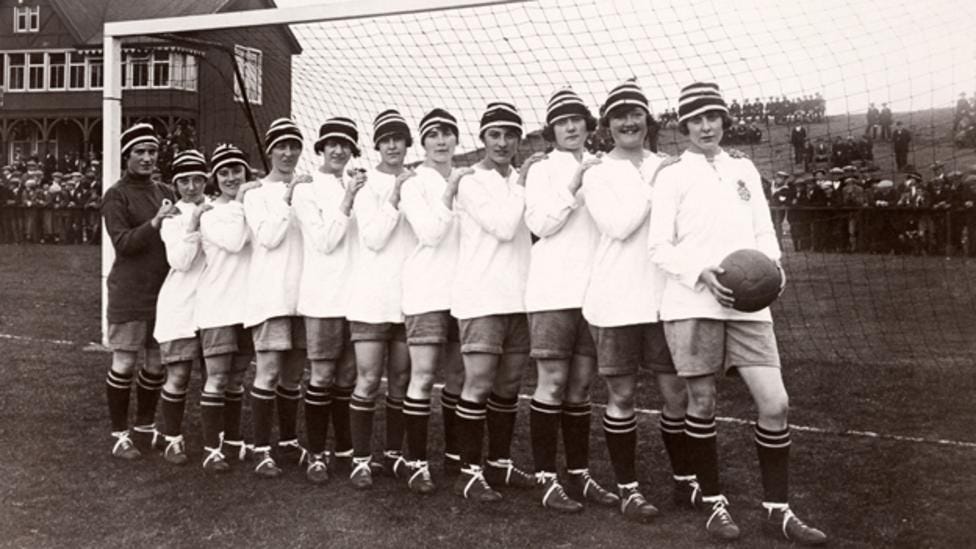
It was a remarkable crowd for any football match. For a women’s team, it was a statement about the size of an audience that already existed.
A century later, football operates on a different scale. The sport has become a global entertainment business, with broadcasting deals spanning continents, transfer fees that make international headlines and clubs whose identities extend far beyond their home cities. Women’s football has also entered a new period of visibility, attracting record crowds, major sponsors and a generation of players who are becoming familiar names well beyond their own competitions.
And yet, the conditions under which women play remain uneven. Some compete in world-class stadiums before enormous audiences. Others struggle with insecure contracts, inadequate facilities and the practical difficulties of building a career around football.
The distance between those realities is often discussed as a question of money. But the story begins much earlier, with a decision that would alter the development of the sport for generations.
In 1921, the Football Association effectively shut women out of its affiliated grounds. Its reasoning was explicit. The consequences were far less temporary than the people who made the decision might have imagined.
The history that followed raises a question relevant to football in 2026: when a sport develops under radically different conditions for men and women, how much of the resulting inequality can reasonably be attributed to the market, and how much has been shaped by the institutions that control the game?
The game before the ban
Women’s football did not emerge as a recent extension of the men’s professional game. Women were playing organised football in Britain during the nineteenth century, and the sport developed considerably during the First World War.
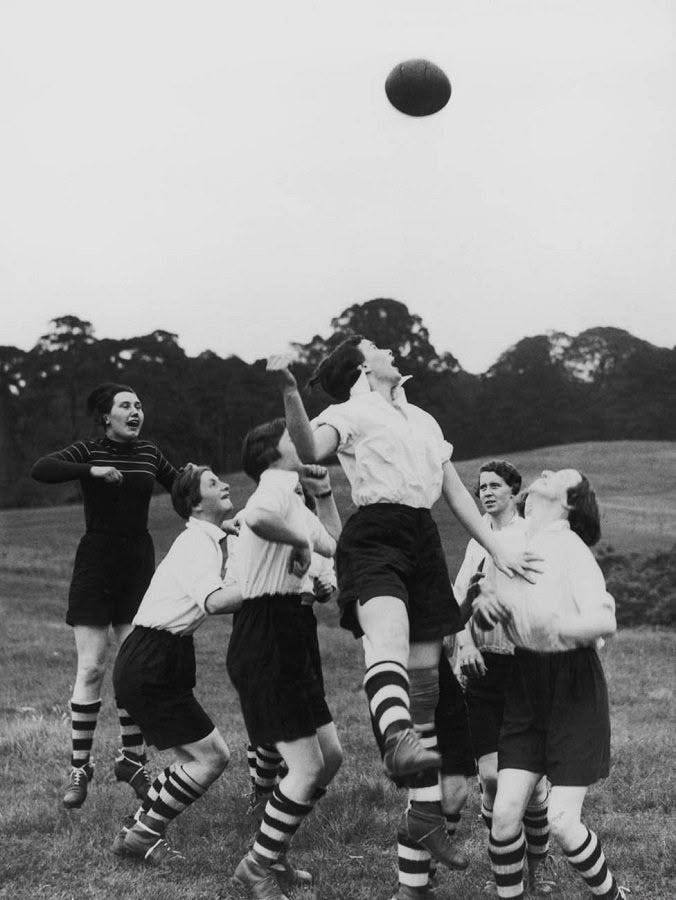
As men left factories to serve in the military, women entered industrial workplaces in greater numbers. Factory teams became an important part of working-class social life, with football offering recreation, community and a public platform for women at a time when their roles were changing rapidly.
The Dick, Kerr Ladies became the most famous of these teams. Based in Preston, they attracted substantial crowds and played matches across Britain. Their Boxing Day fixture in 1920 was a landmark, but it was not an isolated spectacle. The team became a major attraction, demonstrating that women could play competitive football before large audiences.
The game’s popularity existed within a wider struggle over women’s participation in public life. Women had only recently secured the right to vote on the same terms as men in Britain, following the Representation of the People Act 1928, which extended equal voting rights to women aged 21 and over. Questions about women’s physical capabilities, social roles and independence were being contested across society. Football was part of that larger argument.
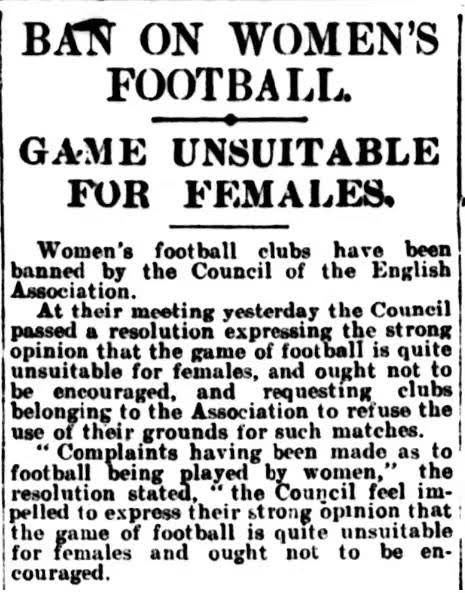
On 5 December 1921, the Football Association announced that its affiliated clubs should no longer permit women’s matches on their grounds. The association declared that football was “quite unsuitable for females and ought not to be encouraged.” It also raised concerns about the handling of match receipts, but the ruling itself rested on a judgement about whether women should be playing the sport at all.
The consequences were substantial. Women continued to play, but they lost access to many of the grounds and networks that could have supported the game’s development. The ruling remained in force until the FA rescinded it in January 1970. In 1971, the association formally permitted women’s football to return to affiliated grounds.
Nearly half a century had passed.
The history is documented by the Football Association and the National Football Museum.
The significance of the ban extends beyond the years during which it was enforced. Football develops through accumulated opportunities: regular competition, access to grounds, coaching networks, youth teams, spectators, media attention and the relationships between clubs and their communities. When those opportunities are restricted, the effects travel forward.
Men’s football continued to develop within an established network of clubs and competitions. Women’s football had to maintain itself at the margins of a system that had formally discouraged its growth.
A prohibition can end on a particular date. The conditions it helped create can persist for decades.
This history complicates the familiar claim that the men’s game simply became more successful because people preferred it. Popularity matters, but it does not develop in a vacuum. Institutions influence which competitions receive attention, which athletes are supported and which audiences are given opportunities to form lasting relationships with a sport.
The women’s game was not starting from nothing when the ban was lifted. It was continuing a history that had been interrupted.
When the market becomes an excuse
There is a persistent argument in football that the men’s game generates more revenue, so it naturally receives more resources. From a purely commercial perspective, the logic appears straightforward. Clubs have costs to cover, broadcasters want audiences and sponsors expect a return.
The problem begins when the current financial position is treated as a complete explanation of how the sport should develop.
Men’s football has benefited from generations of professional infrastructure, regular broadcasting, established international competitions and a vast commercial ecosystem. Those advantages reinforce one another. A strong competition attracts viewers; viewers attract sponsors and broadcasters; the resulting income supports better facilities, recruitment and development. Successful clubs can use their reach to build even larger audiences.
This is a familiar cycle across professional sport. The crucial point is that the cycle has to begin somewhere, and it is much easier to maintain once it has been established.
Women’s football has often been expected to demonstrate the commercial performance of a mature industry while still building many of the structures that allow a mature industry to exist. The difference is not simply that one side generates more revenue. It is that the two sides have not had equivalent opportunities to develop the sources of that revenue.
Consider broadcasting. Audiences cannot follow a competition consistently if matches are difficult to find, schedules are unpredictable or coverage is limited. Sponsors are less likely to recognise the value of a competition that receives little exposure. Young supporters are less likely to build a relationship with players and clubs they rarely get to watch.
Visibility shapes demand, just as demand shapes visibility. Treating those forces as entirely separate misses how football actually grows.
There is also a difference between a club making a sensible commercial decision and an entire sport using its existing commercial hierarchy as a reason to preserve the status quo. Financial discipline matters. So does recognising that the present balance of resources reflects historical decisions, not simply a neutral ranking of potential.
The relevant question is not whether the men’s and women’s games produce identical returns. They do not. It is whether the women’s game is being given a fair opportunity to develop, and whether decisions made today are based on its long-term prospects or on assumptions inherited from a very different era.
The distinction has practical consequences. A club that prioritises short-term revenue above everything else may struggle to develop its academy, retain players or build a sustainable audience. A governing body that treats women’s football as a secondary concern can limit the very growth it later claims to be waiting for.
The market is part of the story. It is not the whole explanation.
The conditions behind the performance
Football is often presented through its most visible elements: the match, the shirt, the stadium, the trophy. But elite performance depends on a network of less visible conditions.
A professional environment includes training pitches, medical teams, recovery facilities, nutrition, transport, coaching, scouting and the everyday organisation that allows an athlete to concentrate on football. These are not decorative extras. They influence how players prepare, how they recover and how long they can sustain their careers.
In women’s football, access to these conditions varies considerably between clubs and countries. Some teams operate within the infrastructure of major men’s clubs, while others have to build their own systems with fewer resources. Shared facilities can offer significant advantages, but they can also mean that women’s teams have to fit around schedules and priorities established elsewhere.
The question is not whether every women’s club should have a replica of a leading Premier League training complex. It is whether each club has the facilities and support appropriate to the level at which its players are expected to perform.
Michele Kang’s approach to London City Lionesses offers one example of a different model. Her plans for a purpose-built training centre, expected to open in 2027, reflect an ambition to create an environment designed around female athletes. The significance lies not only in the building itself, but in the decision to treat women’s football as the starting point of the design rather than an additional requirement within an existing structure.

That principle extends into sports science and medicine. Female athletes have historically been underrepresented in parts of medical and performance research, leaving gaps in knowledge about physiology, injury prevention and recovery. The issue has become increasingly important as women’s football reaches higher levels of physical intensity and professionalisation.
Research into anterior cruciate ligament injuries, for example, has drawn attention to the burden of ACL injuries in women’s football. The causes are complex and involve multiple factors, including biomechanics, playing conditions and training. Better evidence, appropriate prevention programmes and access to high-quality medical support are essential parts of addressing the problem.
These questions cannot be reduced to a simple comparison between men’s and women’s bodies. They require research that takes female athletes seriously on their own terms.
The same applies at grassroots level. Elite players do not materialise at the age of 18 with their technical ability fully developed. Their careers are shaped by years of training, coaching, competition and access to opportunities. If girls have fewer teams available, less convenient training times or limited access to experienced coaches, the effects accumulate long before professional clubs begin recruiting them.
Two players can have similar ability and ambition but very different routes through the game. One may encounter a clear pathway from school football to an academy. The other may have to travel farther, work around limited facilities or leave the sport because the next stage is inaccessible.
Their eventual careers may appear to reflect individual talent alone. In reality, talent has been developed under different conditions.
This is why the future of women’s football cannot be judged only by the quality of its leading teams. Its long-term strength depends on the depth of the game beneath them: the number of girls playing, the quality of local coaching, the accessibility of competitions and the possibility of progressing from one level to the next.
A strong professional league needs a strong football culture around it.
The patriarchy that does not announce itself
The FA’s 1921 ruling was unusually direct. The institution openly declared that football was unsuitable for women and used its authority to restrict their participation. Contemporary inequality is rarely expressed in such explicit terms.
Today, it is more likely to appear in decisions about scheduling, budgets, staffing, facilities or which teams receive the best available resources. Each decision can be defended as a practical matter. The wider pattern becomes visible only when those decisions are considered together.
Patriarchy does not operate exclusively through individual prejudice. It also survives through assumptions about what is normal, valuable and worth supporting.
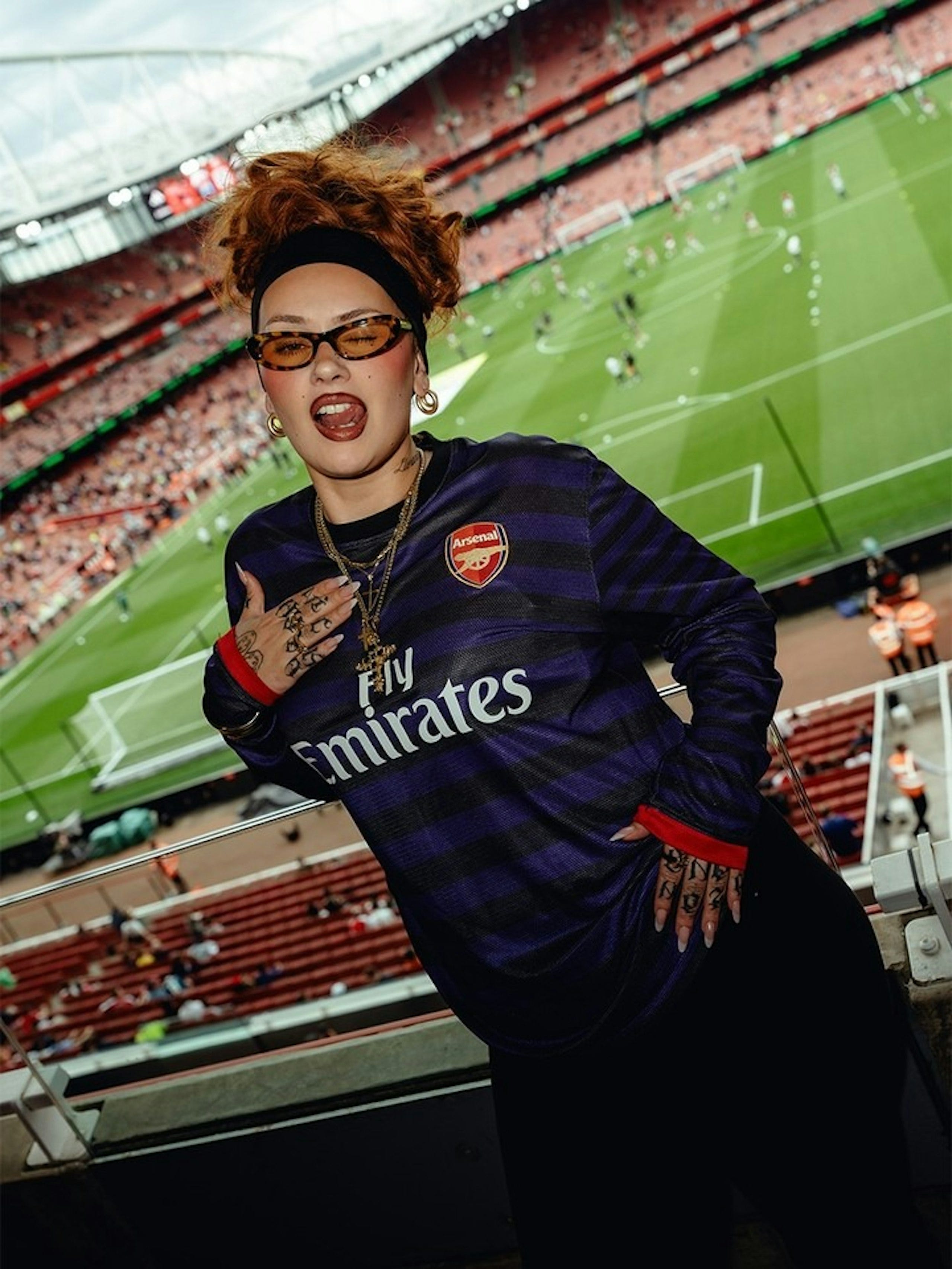
For generations, boys have been encouraged to see football as a natural part of growing up. The sport offers a social language, a source of local identity, a route into friendship and, for some, a possible career. Girls have often encountered different expectations, shaped by the idea that football is primarily a male space or that sporting ambition should occupy a secondary position in their lives.
These expectations influence families, schools, clubs and institutions. They affect which children are encouraged to join a team, which facilities are built and which competitions receive attention. They also influence how sporting achievement is recognised.
Women players can find their technical ability and tactical intelligence discussed alongside disproportionate attention to their appearance, personal lives or suitability as role models. Male players are also subject to scrutiny, but the questions asked of women often carry an additional burden: their presence can be treated as something that must be explained, defended or made palatable to an audience.
The pattern is not universal, and attitudes have changed significantly. Women’s football has supporters, coaches, journalists and administrators who have helped transform the sport. But progress does not mean that the assumptions inherited from the past have disappeared.
One of the more subtle effects of inequality is the way the established order comes to appear neutral. Men’s football occupies the central position, so its needs are treated as the default. Women’s football is framed as an additional category, expected to fit around existing arrangements or demonstrate why it deserves more space.
That distinction shapes the language of the debate. The men’s game is often discussed in terms of its potential, its global reach and its future commercial opportunities. Women’s football is more likely to be asked to prove its value through attendance figures, viewing numbers and revenue growth.
There is nothing wrong with measuring those things. The problem is applying the demand for proof unevenly, as though one side of the sport has an inherent right to exist while the other must continually make its case.
The consequences of a male-dominated history are not limited to who receives a budget. They influence who feels entitled to take up space in football, who is expected to adapt and who gets to be regarded as the natural occupant of the pitch.
Changing that culture requires more than removing formal restrictions. It means examining the everyday decisions through which institutions determine whose ambitions are treated as ordinary.
A professional career, or a professional appearance?
The growth of women’s football has created a striking contrast between its most visible stars and the working conditions of many players elsewhere.
Major tournaments bring packed stadiums, international broadcasting and athletes whose names are increasingly recognised outside football. Leading clubs attract commercial partners and build substantial audiences. These developments matter. They have created opportunities that were difficult to imagine for many players a generation ago.
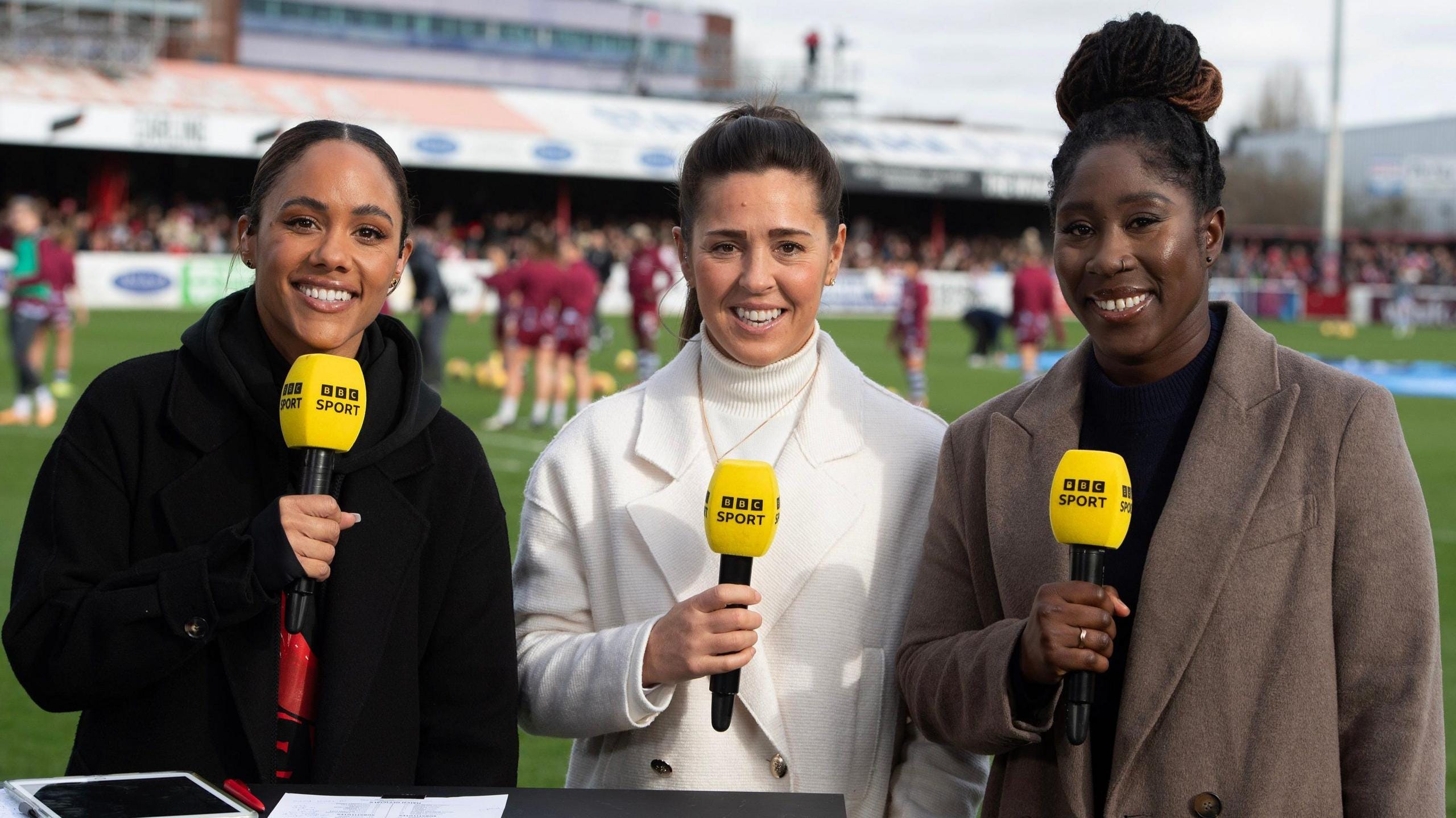
But a sport can become more visible without becoming equally secure for everyone working within it.
In October 2026, FIFPRO published findings from a global employment report based on a survey and interviews involving approximately 800 players. It found that average inflation-adjusted monthly club salary had tripled since 2017, reaching $2,601, while the median was $1,669. Only 56 per cent of players surveyed had an employment contract, and 47 per cent said their clubs lacked sufficient staff. The report also identified significant disparities between countries, including leagues where average player earnings remained below national minimum wage levels.
The findings, published through FIFPRO, complicate the image created by the leading clubs and international competitions. A small group of well-resourced teams can coexist with a global profession in which many players lack financial security, adequate support or the certainty that football can sustain a career.
Professionalism is often used to describe an athlete’s discipline, preparation and commitment. But professionalism also describes the environment in which that athlete works. It requires reliable contracts, medical support, appropriate facilities, time to recover and the ability to devote oneself to training without having to secure a second job to pay the bills.
A player can be exceptional in her approach to football and still work within an employment structure that treats the sport as an unstable occupation. That contradiction is not a reflection of her ambition. It is a reflection of the conditions surrounding her career.
Insecure employment affects more than an individual’s immediate income. It can make it harder to plan for family life, access specialist care, prepare for life after retirement or remain in the game long enough to develop experience. Clubs lose continuity when players leave for more secure opportunities, while leagues struggle to retain talent.
These realities also complicate the idea that the women’s game simply needs more visible role models. Representation matters, but a young player needs more than the image of someone who has made it. She needs a credible route towards doing the same.
The aim should be to make professional football a sustainable occupation across a wider range of clubs and countries, rather than a viable career for a relatively small group of elite players.
The audience has already arrived
The attendance figures from recent women’s football tournaments have become familiar enough to risk losing their significance.
UEFA Women’s EURO 2022 in England drew 574,875 spectators, including 87,192 for the final between England and Germany at Wembley. Three years later, Switzerland set a new tournament attendance record, with 657,291 spectators across 31 matches. The 2025 competition demonstrated that major women’s football events can attract enormous crowds across an entire tournament, not only for a single final.
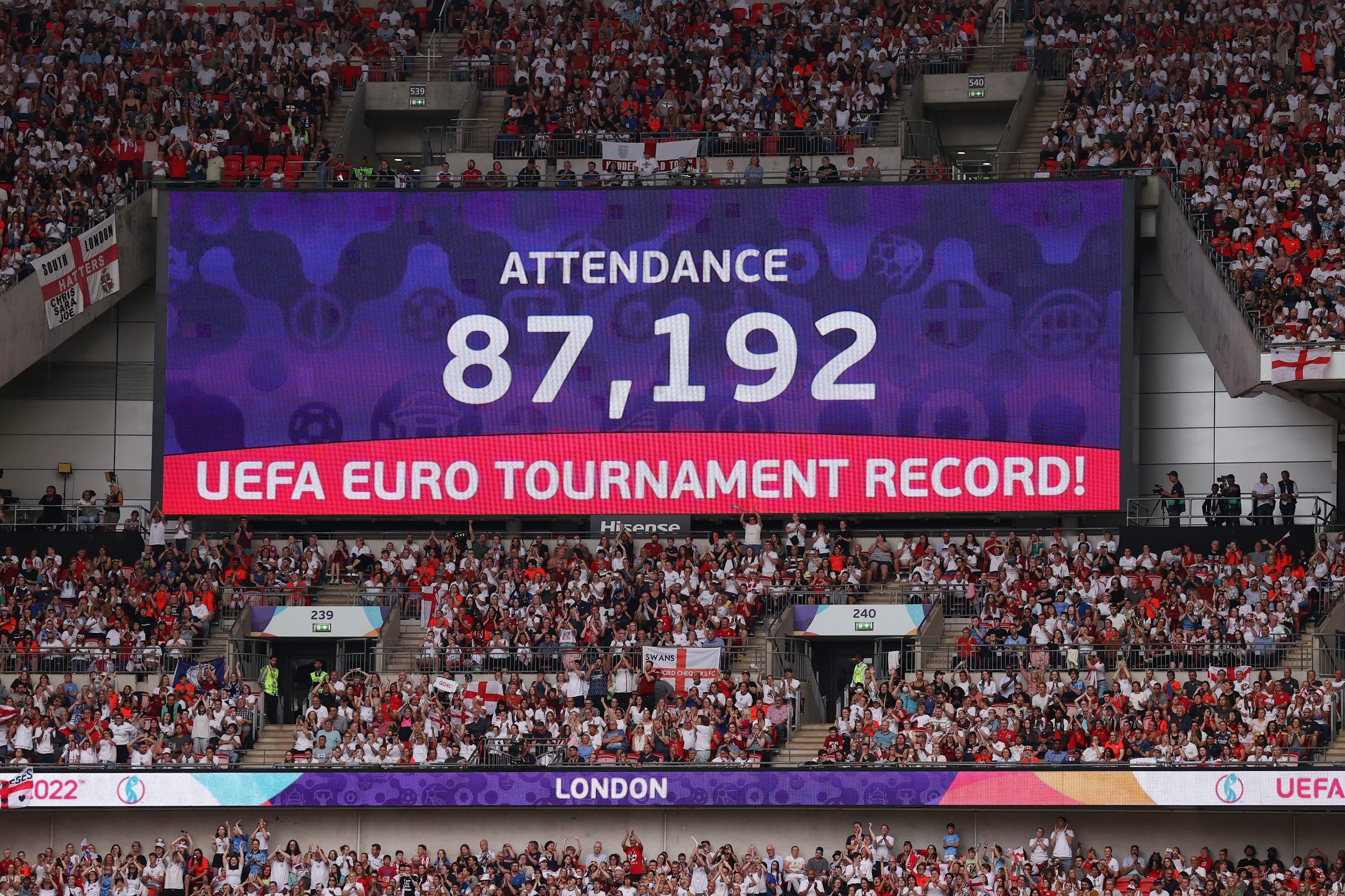
The club game is developing too. Barcelona’s women’s team has drawn substantial crowds at the Camp Nou, while clubs across Europe have worked to turn occasional high-profile fixtures into more consistent relationships with supporters. The scale of that progress differs between leagues, but women’s football is no longer a proposition whose audience exists only in theory.
The financial picture is changing alongside it. Deloitte’s 2026 Women’s Football Money League reported that the fifteen highest-revenue women’s clubs collectively generated €158 million in the 2024/25 season, a 35 per cent increase on the previous year. Average revenue among those clubs exceeded €10 million for the first time.
The figures require context. The leading clubs do not represent the entire women’s game, and revenue can include commercial agreements and support from wider club organisations. Growth at the top does not automatically translate into security throughout the football pyramid.
Still, the direction is significant. The sport is creating commercial opportunities, attracting supporters and giving broadcasters and sponsors reasons to pay attention. The task now is to turn that attention into durable structures: accessible tickets, reliable scheduling, consistent coverage, strong youth pathways and competitions that supporters can follow throughout a season.
A packed stadium is an achievement. A league capable of producing the next generation of elite players is a different achievement. The future depends on both.
There is also a cultural dimension that cannot be measured entirely through revenue. Women’s football has its own histories, rivalries, communities and styles of play. Its players are building public identities and influencing the way younger generations encounter the sport. Supporters are not simply transferring their interest in men’s football to another category. They are developing relationships with teams and players in their own right.
The women’s game does not need to become a replica of the men’s game to justify its place. It needs room to develop its own culture, audiences and commercial models, supported by the conditions that professional sport requires.
What the next century looks like
Football is approaching the end of 2026 with more evidence of the women’s game’s potential than at any previous point in its modern history. International competitions are attracting record crowds. Leading clubs are generating growing revenues. Players are performing at the highest level while continuing to expose the uneven conditions under which the profession operates.
Yet visibility and opportunity remain different things. A player can become globally recognisable while girls in her hometown still struggle to access regular coaching. A tournament can sell out while professionals elsewhere lack secure contracts. A club can celebrate its women’s team while the team continues to operate around facilities and schedules designed primarily for someone else.
This is the contradiction at the heart of the current moment. Football has become increasingly comfortable celebrating the women’s game. Celebration is visible, immediate and easy to communicate. Structural change is slower. It requires consistent decisions about facilities, research, employment, coaching, broadcasting and the development of players long before they become stars.
The women who played before the 1921 ban understood that football was worth playing even when the institutions around them refused to make space for it. The generations that followed kept the game alive through decades in which its development was constrained. Today’s players are competing in a world where the audience is larger, the commercial possibilities are clearer and the quality of the football is increasingly difficult to overlook.
The challenge is to stop treating the consequences of unequal opportunity as evidence of unequal potential.
There is no single solution, and the needs of a global sport will vary between countries, leagues and clubs. But the direction should be clear: stronger grassroots pathways, better employment conditions, appropriate facilities, more serious attention to female athletes’ health, and a football culture in which girls do not have to justify their presence before they are allowed to develop their ability.
The question raised by that crowd at Goodison Park in 1920 was never simply whether people would watch women play football. Thousands already had.
The question was what the sport would allow those players to become.
A century later, football has the opportunity to answer differently.

If you are interested in becoming a GUAP contributor and telling stories that matter to the culture we want to hear from you. We commission emerging writers, journalists and video creators every month to cover the people, communities and moments our audience needs to discover. Your subject. Your voice. No brief.
For more information/submit a story - click here.

Consider becoming a paid subscriber and gain access to:
The full GUAP Daily: five deep-dive articles/video essays written by and for the culture, a week straight to your inbox, Monday to Friday.
The Sunday opportunities newsletter - jobs, freelance roles, commissions, casting calls and industry openings every week
Monthly online events - masterclasses, workshops, live interviews and community gatherings ran by OURPPLS.
Discounts/Perks from our community partners including Tunecore,
For only £6 a month (price of a coffee) you get access to the opportunities, the knowledge and the community that keeps you close to the culture. Whether you are building something or you just care about what is happening - this is where you want to be. And every membership puts money directly into the hands of the writers and creators telling the stories that actually matter.