




In 1984, Jim Jannard was driving along California’s Pacific Coast Highway when sunlight began entering his sunglasses from the side. The problem seemed banal until he compared them with the motocross goggles he had been developing. The goggles covered the face properly. The sunglasses did not.
So he went home and made something new.
The first prototype for what became Oakley’s Eyeshade was assembled from a Lexan goggle lens, a coat hanger and electrical tape. It looked less like an accessory than a piece of sporting equipment that had escaped its intended environment. Oakley would spend the following decades turning that attitude into a design language: wraparound lenses, sculptural frames, technical materials, objects that seemed to belong to a future in which sports equipment no longer had to apologise for looking strange.
Fifteen years later, a footballer walked onto a pitch wearing a pair of them.
And suddenly, the history of Oakley became entangled with the history of Edgar Davids.
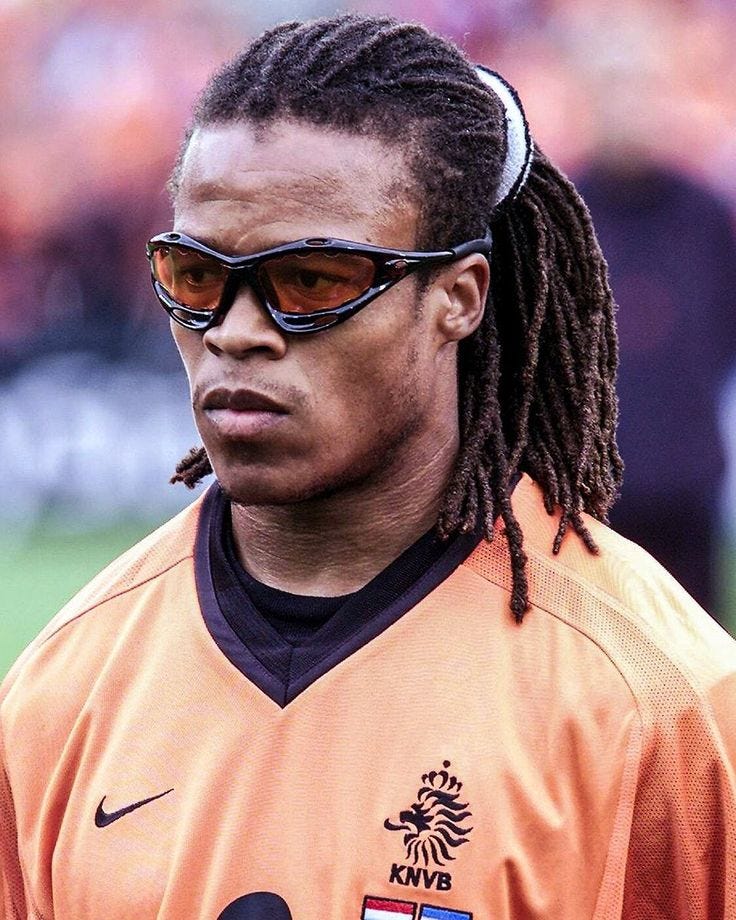
There is something almost perversely appropriate about the fact that the most recognisable accessory in Davids’ career was not chosen because he wanted to look distinctive.
He needed it.
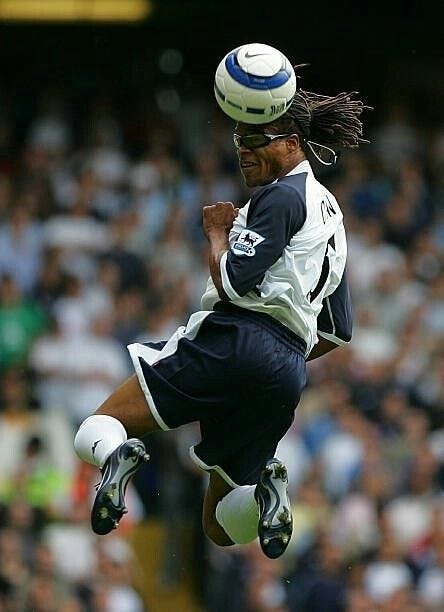
Davids developed glaucoma after a series of eye injuries in 1995 and underwent surgery. By 1999, he was playing in protective glasses. He first wore them publicly for the Netherlands against Belgium in September of that year. The orange-tinted lenses were functional too. Davids later explained that the colour helped him distinguish the white ball against the green pitch.
The object had a medical purpose.
Davids gave it a cultural one.
By the time Euro 2000 arrived, the glasses had become so inseparable from him that Le Monde was already writing about the strange spectacle of a Juventus midfielder walking around Amsterdam in black wraparound frames and orange lenses. The newspaper noted that the original medical necessity had developed into something else: Davids had simply grown attached to them.
That is one of the great accidents in football style.
Something happens to your body, you find a way to accommodate it, and eventually the thing that was supposed to make you less conspicuous becomes the first thing everyone notices.
But the glasses only worked because there was already an Edgar Davids underneath them.
He had been building that character for years.
Born in Paramaribo, Suriname, in 1973 and raised in the Netherlands, Davids belonged to a generation of Dutch footballers whose presence complicated the country’s increasingly polished image of itself. The Netherlands of the 1990s was often sold abroad through the elegance of Total Football, Ajax academies and an almost architectural idea of how football should be played. Davids represented another side of that story: Surinamese heritage, Amsterdam street football, Black Dutch identity, basketball, hip-hop and an appetite for everything that existed outside the conventional football curriculum.
His world was larger than football.
A remarkable 1999 profile by Simon Kuper captures this better than most biographies do. Kuper describes Davids as an autodidact obsessed with basketball players and rappers, someone who collected tricks rather than football trivia. When he was excluded from the Dutch squad for the 1994 World Cup, he spent the tournament playing on Amsterdam playgrounds and practising things he had seen on television.
That detail is revealing.
Davids wasn’t simply learning football from football, he was absorbing culture.
And you can see it in the way he eventually looked.
The dreadlocks were part of it. The jewellery was part of it. The glasses were part of it. The clothes were part of it. None of these elements existed in isolation because Davids did not seem interested in the idea that a footballer had to have one carefully approved version of himself.
He was curious, confrontational, occasionally difficult, and incredibly good.
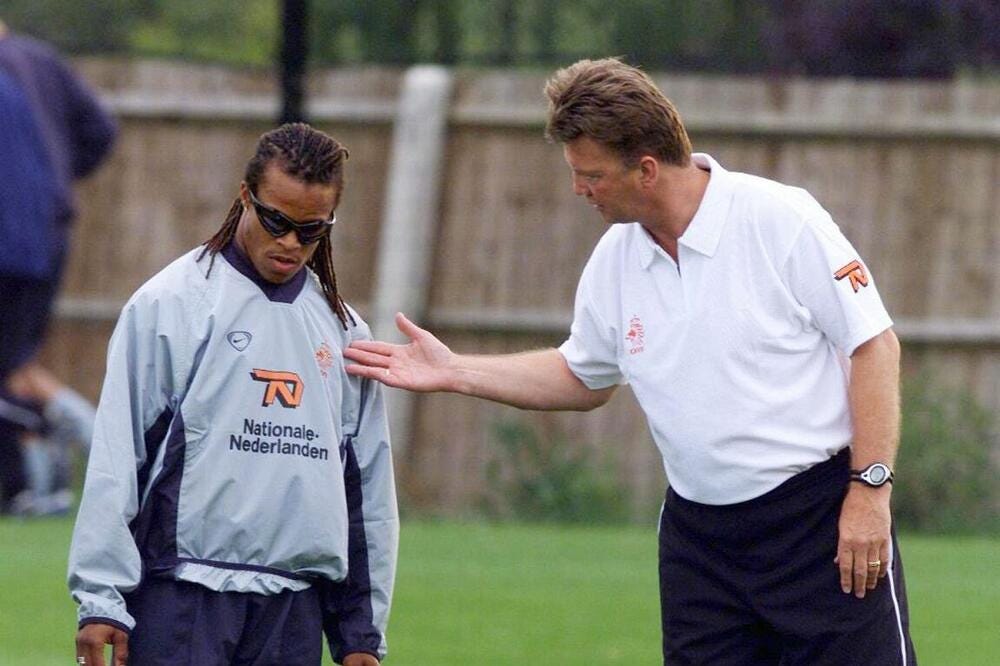
At Ajax, Louis van Gaal gave him the nickname that would follow him for the rest of his career: the Pitbull. It was not particularly poetic, but it was accurate. Davids was tenacious, aggressive and relentless in midfield, a player whose size was almost irrelevant to the amount of territory he could occupy.
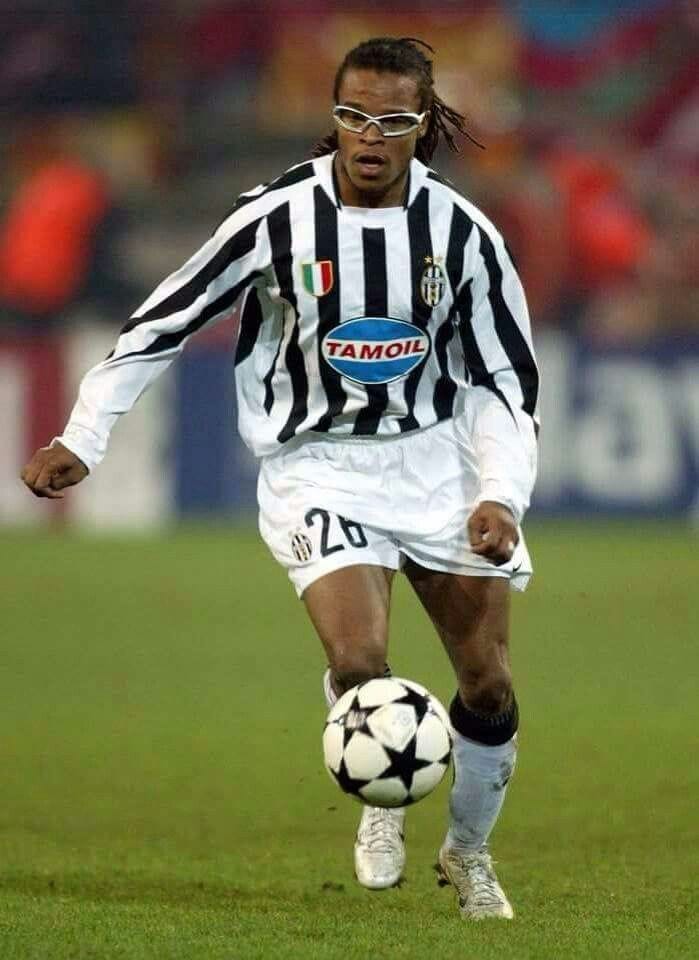
He won the UEFA Cup with Ajax in 1992 and the Champions League in 1995. After a difficult period at Milan, he moved to Juventus in December 1997 and became one of the most important players in Marcello Lippi’s midfield. By the late 1990s, he was no longer simply one of the young products of Ajax’s academy. He was one of the defining midfielders in European football.
The Juventus years are where the visual lore really crystallised.
There was Zidane, all height and grace, making the game appear almost weightless.
There was Del Piero, with his immaculate technical precision and cultivated Italian elegance.
And then there was Davids.
Shorter. Faster. Dreadlocked. Goggles on. Legs constantly moving. Tackling as though possession were something that had been personally stolen from him.
He looked almost futuristic in a team whose image was otherwise rooted in the grandeur of European football.
The contrast mattered because Davids wasn’t beautiful in the traditional footballing sense. He was compelling.
That is a different quality. Beauty asks you to look, compulsion makes you keep looking. And trully, his personality helped.
The same 1999 Kuper profile begins with Davids telling the journalist that he is badly dressed. He had apparently done this before. The article describes a player who was aggressive, proud, volatile and extremely certain of his own judgement. At one point he approached tennis player Richard Krajicek in an Amsterdam bar, introduced himself despite being unknown to him and confidently announced that he would soon be playing for Holland and driving a big car.
It sounds almost fictional, but that is the thing about Davids. He had the peculiar quality of somebody who seemed to have already imagined his own mythology.
And fashion, for him, was not a decorative afterthought.
He understood clothes as another form of language.
In 1999, the same year his goggles were becoming inseparable from his footballing identity, Davids founded Monta Soccer in Amsterdam.
The timing is extraordinary.
The contemporary relationship between football and fashion can make it difficult to remember how divided those worlds once were. Performance clothing belonged to sport. Streetwear belonged somewhere else. A footballer might wear expensive trainers and denim away from the pitch, then change into a tracksuit for training. The two wardrobes had different purposes and different ideas about who they were for.
Davids thought that separation was ridiculous.
He later described street football as inseparable from fashion and said that, when he was playing, the options were essentially limited to tracksuits that made players look as though they were on their way to the gym. Monta was designed to occupy the space between on-pitch performance and off-pitch lifestyle.
The reaction to the brand was telling.
People did not know what category it belonged to, was it sport or was it lifestyle?
That uncertainty is almost a perfect description of Davids himself.
He was a footballer who wanted to understand fashion, a sportsman interested in design.
A Dutch player born in Suriname who became synonymous with Italian football.
A man whose most famous accessory came from a medical condition but became a marker of personal style.
A player whose image was aggressive while his creative interests were surprisingly expansive.
The categories kept failing him, but Davids seemed to enjoy that.
Years later, he took the fashion interest further. While living in London, he studied at Central Saint Martins, learning about design, materials and the business behind fashion. Forbes described the transition from football into fashion as organic, pointing out that Davids had already created Monta more than a decade before pursuing formal fashion education. He later developed Monta Heritage, a more refined continuation of the original concept.
That part of his story is often treated as a footnote.
It shouldn’t be.
Because it changes the way we understand everything that came before it.
Davids wasn’t a footballer who happened to dress well, he was somebody genuinely interested in the mechanics of style. He wanted to understand why things worked.
In a 2016 interview about fashion, photography and surrealism, he spoke about learning the entire creative process at Central Saint Martins, from concepts and drawing to materials. He also designed shoes, working through the process from the initial idea to the factory.
There is a particular intelligence in that trajectory.
Most athletes become interested in fashion because fashion becomes interested in them while Davids seems to have gone in the opposite direction.
He was already looking. This is perhaps why his image feels surprisingly contemporary now.
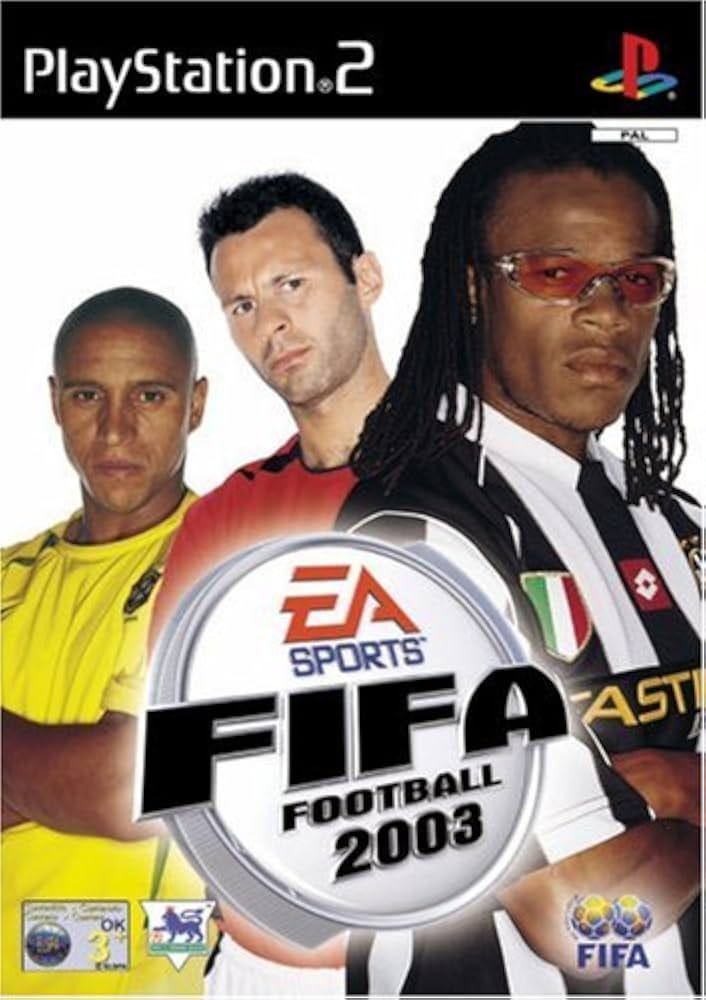
Football has become one of fashion’s most productive cultural territories. Players are no longer merely photographed in their uniforms. Their arrival at the stadium can generate almost as much attention as the match. Their clothes become editorial material. Football shirts move through streetwear. Luxury brands sign players. Players become collaborators, ambassadors, designers and, increasingly, brands in their own right.
Davids himself has spoken about how different the landscape would have been for him today. When he was playing, dressing rooms were much more uniform. Social media has made every player’s clothing visible, allowing footballers to express themselves in ways that would have been less noticeable in his era. He said, rather tellingly, that he would have had “a ball” with today’s freedom.
Of course he would.
Imagine Edgar Davids in 2026. He would have been unbearable, and probably brilliant.
The interesting thing is that he does not need to be retroactively inserted into contemporary fashion. Contemporary fashion keeps finding its way back to him.
GQ Netherlands recently revisited his wardrobe, moving from Amsterdam streetwear label Patta to Roberto Cavalli and looking back at outfits from the early 2000s alongside his more recent appearances. The point isn’t that Davids has maintained one fixed aesthetic. Quite the opposite. He has always been able to move between streetwear, tailoring, luxury and sportswear without losing the underlying character.
That is what makes the image durable; Trends change, Davids doesn’t really have a trend.
He has a vocabulary and the vocabulary is much broader than the goggles.
The goggles simply happen to be the punctuation mark. They made his face immediately legible.
Put him in a Juventus shirt and he was Davids, put him in a Netherlands shirt and he was Davids, in streetwear and he was Davids, in Cavalli and, somehow, still Davids.
That is harder than it sounds!
Most people with a strong aesthetic become trapped by it. The signature becomes costume. The thing that once distinguished you eventually becomes the thing that prevents you from changing.
Davids managed to avoid that.
The clothes evolved, the silhouette changed, the environments changed, yet the personality remained recognisable.
And there is another reason the glasses matter: they complicate the usual relationship between disability and image.
In most celebrity culture, an imperfection is something to conceal, correct or work around until it disappears from the photograph.
Davids did the opposite.
The thing that marked a vulnerability became the thing that made him visually indestructible.
There is something almost beautiful about that transformation, but it is also very practical. Davids never presented the glasses as some elaborate act of rebellion. They were functional. He needed them. He continued playing.
The fashion happened afterwards.
That distinction is important because it explains why they never looked like a costume.
He wasn’t wearing the future, he was wearing what he needed.
And because Edgar Davids was Edgar Davids, what he needed happened to look extraordinary.
Oakley had spent years making eyewear that borrowed from motocross, cycling and other forms of high-performance sport. Its original philosophy was rooted in experimentation, engineering and a refusal to make sports equipment look conventional.
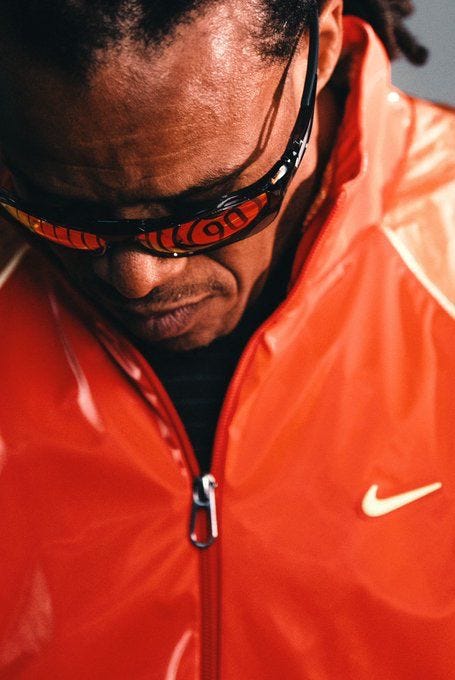
Davids took that philosophy somewhere Oakley probably could not have predicted and that is why Edgar Davids is more interesting than the phrase “football style icon” allows.
His influence isn’t simply that footballers later started caring about clothes.
It is that he demonstrated how a person could become an aesthetic without becoming artificial.
His appearance wasn’t separate from his temperament. His clothes weren’t separate from his interests. His football wasn’t separate from his personality. The contradictions were the point.
The glasses were medical -> The glasses became fashionable.
The footballer became a fashion figure -> The fashion figure went back to studying.
The street player built a brand -> The aggressive midfielder became interested in surrealism, photography, design and materials.
The man who once told a stranger he was badly dressed eventually became the person whose own wardrobe would be revisited decades later as a source of inspiration.
There is a lovely absurdity to the whole thing.
A pair of goggles originally designed for athletes became one of the most recognisable objects in football while a player born in Paramaribo became one of the defining faces of Amsterdam and Turin.
A man famous for breaking up attacks became an unlikely bridge between football, street culture and fashion and a medical necessity became one of the strongest pieces of visual authorship in the history of the sport.
You can still see the original logic in the photographs. It doesn’t look like somebody trying to create an icon, it looks like somebody who had become too specific to be mistaken for anyone else.
That is probably the highest form of style.
Not being ahead of fashion or being dressed better than everyone else. Not even being particularly fashionable.
Just being so completely, stubbornly yourself that eventually the rest of the culture has to find a vocabulary for you.

If you are interested in becoming a GUAP contributor and telling stories that matter to the culture we want to hear from you. We commission emerging writers, journalists and video creators every month to cover the people, communities and moments our audience needs to discover. Your subject. Your voice. No brief.
For more information/submit a story - click here.

Consider becoming a paid subscriber and gain access to:
The full GUAP Daily: five deep-dive articles/video essays written by and for the culture, a week straight to your inbox, Monday to Friday.
The Sunday opportunities newsletter - jobs, freelance roles, commissions, casting calls and industry openings every week
Monthly online events - masterclasses, workshops, live interviews and community gatherings ran by OURPPLS.
Discounts/Perks from our community partners including Tunecore,
For only £6 a month (price of a coffee) you get access to the opportunities, the knowledge and the community that keeps you close to the culture. Whether you are building something or you just care about what is happening - this is where you want to be. And every membership puts money directly into the hands of the writers and creators telling the stories that actually matter.
