




His father, Albert, was a psychiatric nurse and painter. His mother, Éléonore, was a dressmaker. His grandfather was a Catalan refugee and painter. The family lived in Les Caillols, on the eastern edge of Marseille, in a house built into a hillside cave. Albert would stop the family car because the light had changed on a mountain. He took Eric to exhibitions. Eric watched him paint, then started painting himself. By 15, he had left school for Auxerre, but he continued painting while away from home.
In 1988, some of his paintings were exhibited in Marseille, violent, expressionist works full of colour, fire and dollar imagery. Cantona later described his culture as fundamentally visual, born from observation.
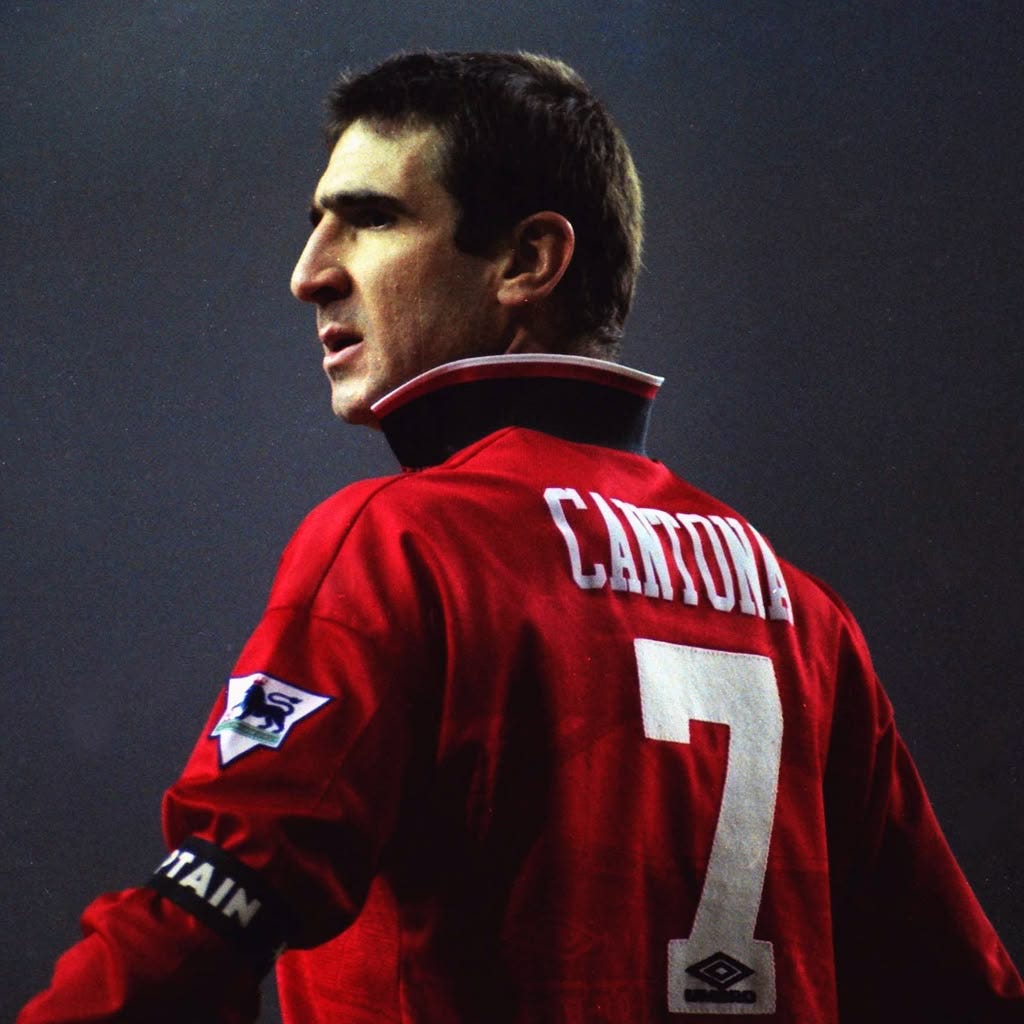
That childhood is rarely mentioned when Cantona is reduced to the raised collar, the four Premier League titles, the kick at Selhurst Park and the seagulls.
It should be the beginning.
Because Cantona’s real subject was never simply football. It was intensity. Football was the first place he found it. Then came music, clothes, cinema, painting, theatre, politics, Manchester, celebrity and, eventually, the deliberate act of becoming a beginner again.
The King was always more restless than the crown suggested.
Before Manchester
The French football establishment struggled with him long before England fell in love with him.
Cantona had enormous talent and a temperament that made authority feel negotiable. He played for Auxerre, Marseille, Bordeaux, Montpellier and Nîmes, won the French league and represented France, but his career repeatedly collided with managers, referees and disciplinary committees. He insulted France manager Henri Michel, fought with teammates, reacted badly to substitutions and, at Nîmes, threw a ball at a referee before insulting the disciplinary committee that suspended him.
His punishment was increased. At 25, he announced his retirement from football.
It is easy to call this immaturity.
A more revealing interpretation is that Cantona had an unusually developed sense of authorship. He wanted to determine the terms on which he existed. He could accept authority when he respected the person exercising it, but arbitrary authority appeared to him as an insult to his intelligence.
Michel Platini was one of the rare figures he respected enough to influence him. The route to England eventually came through Leeds United, where Cantona helped win the 1991-92 title.
Then Manchester United came calling.
The timing was almost perfect.
The Premier League had just been created. Football was becoming television, television was becoming celebrity, and English clubs were beginning to understand that a footballer could sell an idea of a city, a lifestyle and a personality as effectively as he sold shirts.
Cantona arrived in November 1992 for around £1.2 million.
Four months later, Manchester United were champions for the first time in 26 years.
The Player
Everything that happened culturally depended on one fact: Cantona could fucking play.
He was not a footballer who became interesting because he dressed well or spoke strangely. He was one of the most intelligent attacking players of his generation.
He could receive between the lines, protect the ball, turn under pressure, play the final pass, score from distance, arrive in the box and alter the rhythm of an entire attack. He was physically powerful but unusually delicate with the ball. He could make a difficult pass look casual and a simple pass feel significant.
Manchester United’s official record gives him 182 appearances and 82 goals. He won four Premier League titles and two FA Cups in four and a half seasons.
But statistics don’t explain the phenomenon.
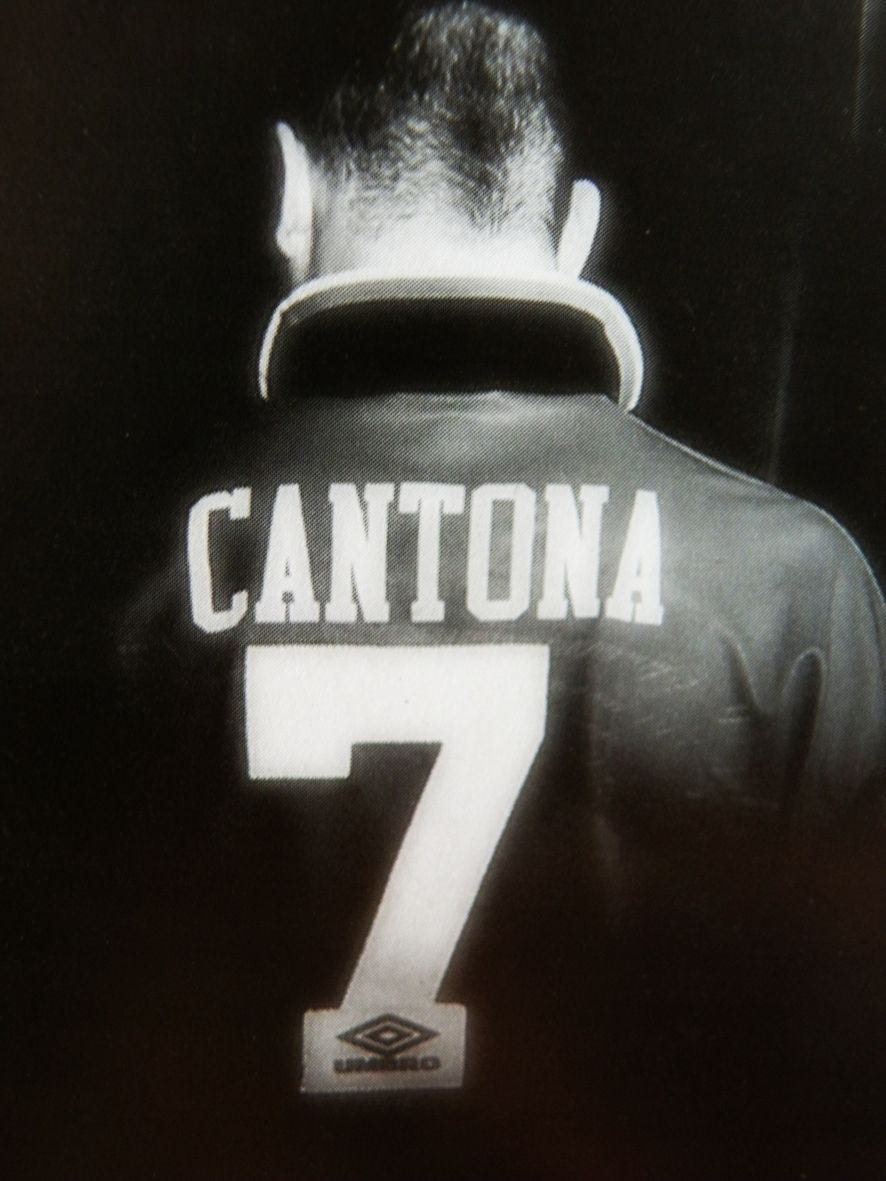
Cantona altered the psychological atmosphere of Manchester United.
He arrived when Ferguson’s young players were still becoming themselves. Beckham, Giggs, Scholes and the rest of that generation grew up around a footballer who behaved as though winning was less an ambition than a natural state.
That distinction matters.
Cantona did not merely demonstrate confidence. He transmitted it.
His teammates saw someone who seemed to believe that the decisive moment belonged to him before the decisive moment had arrived.
That became part of Manchester United’s identity.
The Collar And The Code
The collar became famous because it was unnecessary.
Everybody wore the same Manchester United shirt. Cantona wore his differently.
The gesture was tiny, but it established a principle that would run through his entire career: the uniform is never quite enough.
There must be something personal added to it.
Away from the pitch, that instinct placed him inside the rapidly evolving culture of football fashion.
Stone Island was particularly important. Through the casual movement, British supporters had begun travelling around Europe and returning with Italian sportswear, technical fabrics and labels that carried information about where you had been and what you knew. The compass badge became a kind of cultural passport.
Cantona helped move that language into the mainstream.
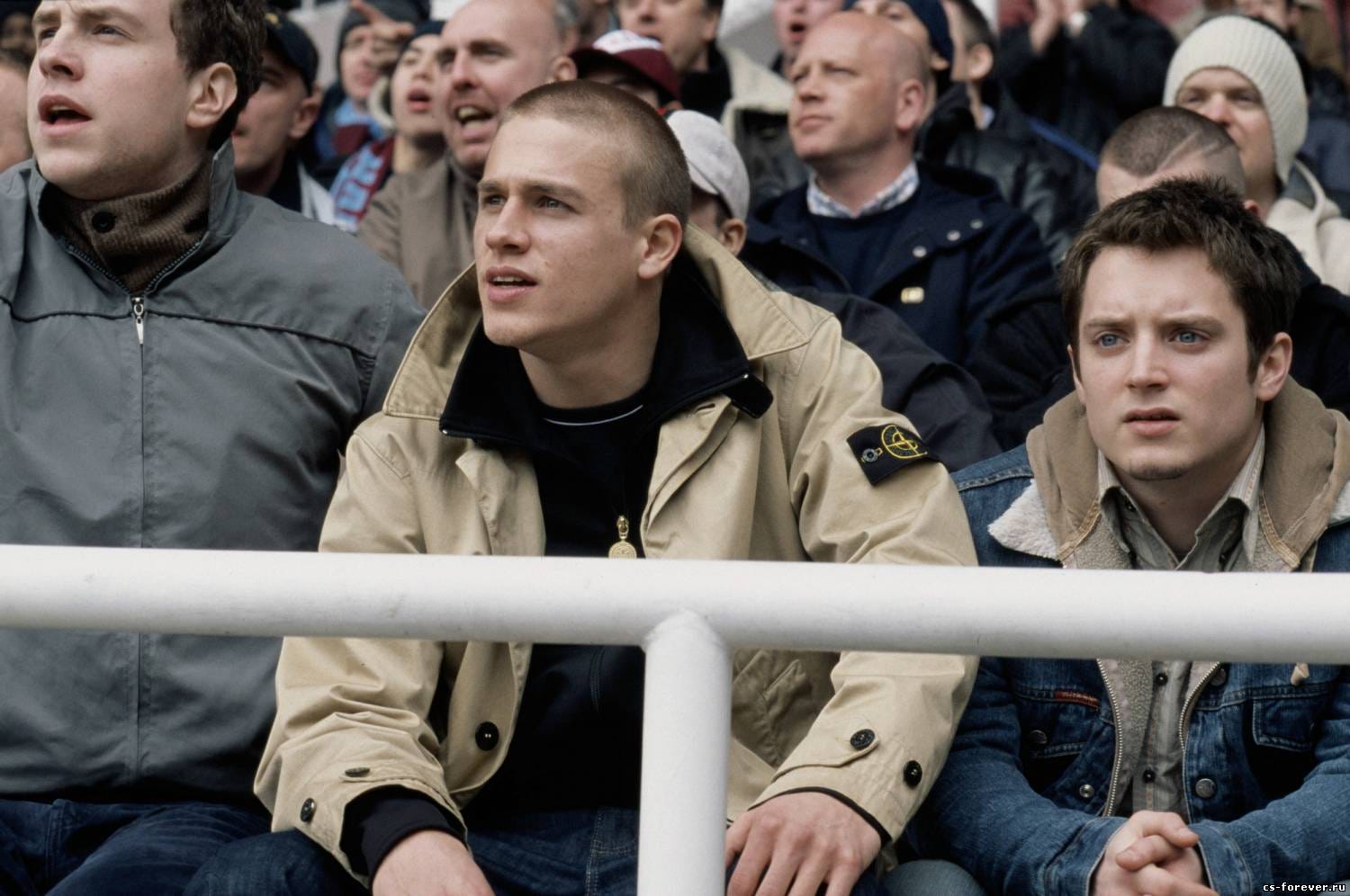
Stone Island chairman Carlo Rivetti has recalled Cantona buying the brand in Manchester and appearing on television wearing the badge, describing him as a crucial trigger in its British breakthrough.
But Stone Island was only one component.
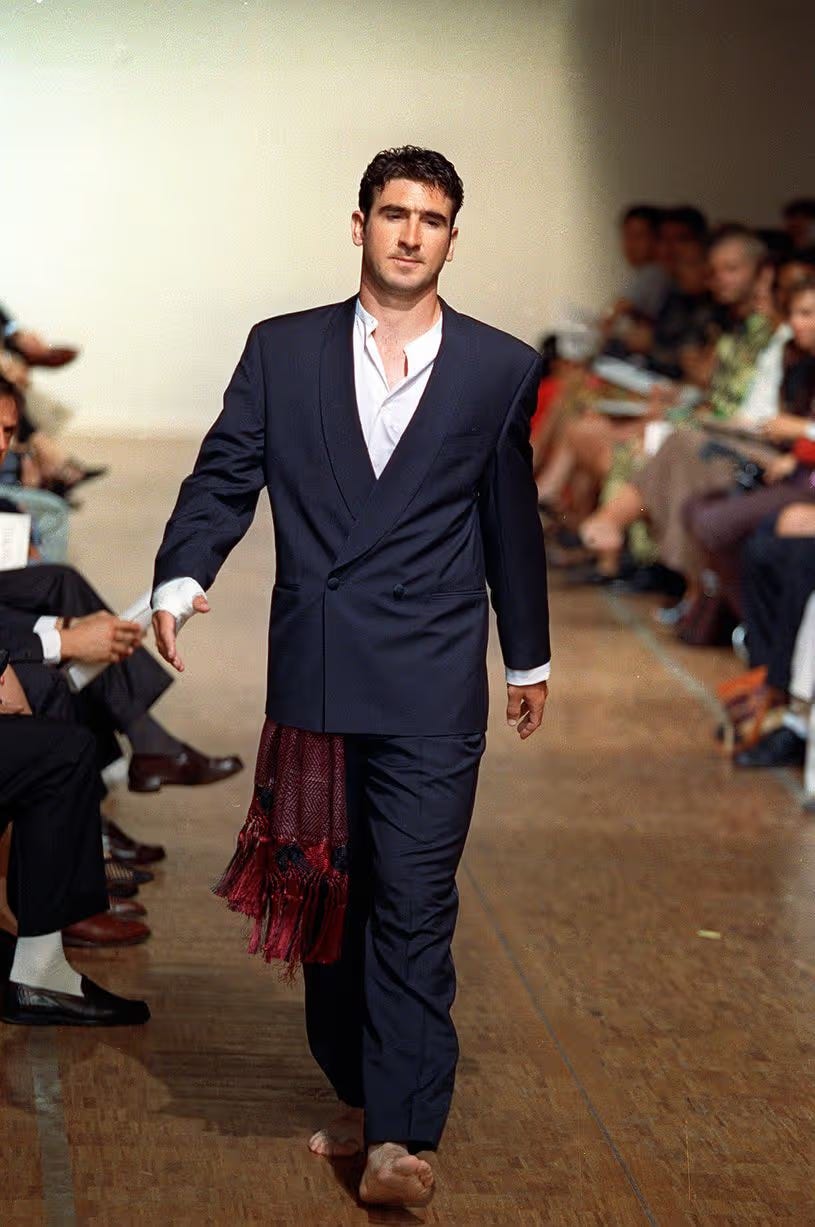
There was Umbro, whose oversized 1990s Manchester United shirts and enormous collars became inseparable from Cantona’s silhouette. There was Paco Rabanne, where he appeared on a Paris runway in 1993. There was the wider world of European sportswear, tailoring and terrace fashion that was beginning to collapse the distinction between what a footballer wore to play and what a footballer wore to be seen.
Cantona was early to this. Not because he was trying to be fashionable, but because he understood that clothes communicate before people do.
Manchester
Then there was the city.
Cantona arrived in Manchester while football, music and fashion were undergoing a particularly strange collision. The Stone Roses, Happy Mondays, The Smiths and Oasis were constructing different versions of what Manchester could mean. The Hacienda existed, but Cantona and his close friend Basile Boli often preferred smaller venues such as Band on the Wall and the Boardwalk. They went to see Acid Jazz, Everything But the Girl and Massive Attack.
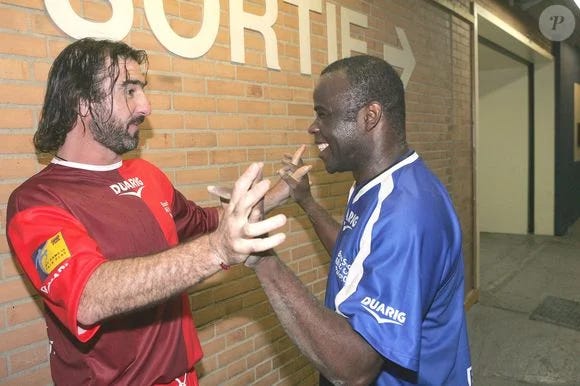
Cantona loved the Stone Roses and Oasis, including the volatile relationship between Liam and Noel Gallagher.
They also went to the Cornerhouse to watch independent films and discuss them afterwards. Cantona was a member of the Portico Library.
That detail is extraordinary.
The most famous footballer in Manchester was spending his evenings in an independent arts centre and library, watching films and reading, while the city around him was becoming the centre of British popular culture.
He was not simply absorbing Manchester, he was curating his own version of it, and that is where the comparison with David Beckham becomes fascinating.
Beckham would later become the perfect global celebrity because he understood visibility, polish, aspiration and commercial clarity.
Cantona represented almost the opposite model.
The Footballer Becomes Cinema
By the mid-1990s, Cantona was no longer contained by football.
Paco Rabanne had put him on a runway, Nike put him in a cinematic universe.
Good vs Evil, released in 1996, placed Cantona alongside Ronaldo, Maldini, Figo, Kluivert and Ian Wright in a Roman amphitheatre against a demonic team. Nike was still a challenger in football. The advertisement changed that. Cantona scored the decisive goal, flipped his collar and said, “Au revoir.” Children across Europe began recreating the scene in playgrounds.
This was more important than a brilliant advertisement.
Nike had discovered that football could be sold like cinema. Cantona was perfect for that transition because he already looked cinematic.
The stare, the collar, the stillness, the French accent, the sudden violence, the exaggerated sense of destiny.
He didn’t need to be turned into a character because he already was one.
And yet the remarkable thing about Cantona is that the persona never completely swallowed the footballer.
The football was always there to authenticate the image.
SElHURST PARK
Then, on 25 January 1995, the boundary between performance and reality disappeared.
Cantona was sent off against Crystal Palace. As he walked towards the tunnel, Palace supporter Matthew Simmons followed him, shouting abuse.
Cantona turned. He kicked him.
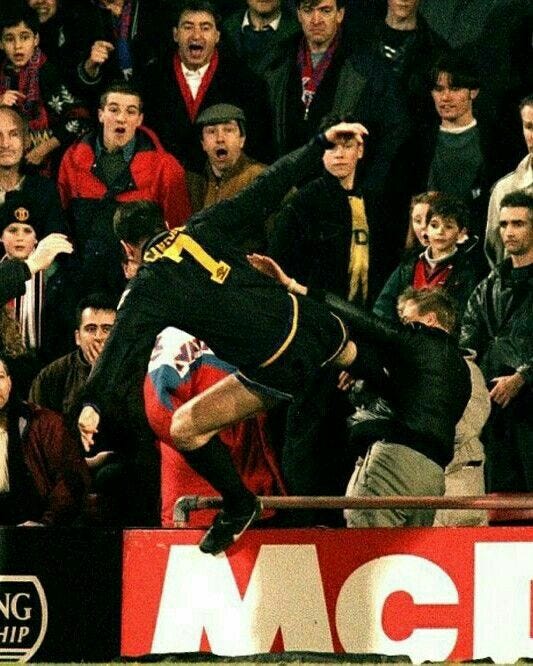
The photograph became one of the defining images of 1990s Britain.
The punishment was enormous: an eight-month suspension.
The incident is often treated as the moment Cantona lost control.
Psychologically, it is more revealing than that.
His entire identity was built around autonomy. He could tolerate being challenged, but he had a profound problem with humiliation and imposed authority. The kick was an eruption of exactly the quality that had made him fascinating.
His strength and his weakness were the same thing.
He refused to become manageable.
The Seagulls
Then came the press conference. Everyone expected remorse.
Cantona talked about seagulls following trawlers because they believed sardines would be thrown into the sea.
It became one of the most famous sentences in football.
People laughed because it sounded incomprehensible.
But Cantona understood something about media that most footballers of his generation had not yet learned.
A press conference is also theatre. The journalist controls the question, celebrity can control the frame.
Cantona refused the expected script and replaced it with an image that nobody could quite decode.
It was absurd, but it was also strangely elegant.
The world wanted to turn him into a disgraced footballer.
He made himself impossible to summarise.
That became his defence.
Nine Months
The suspension did something unexpected.
It gave Cantona time to find out who he was when football was unavailable.
He explored cinema. He painted. He became more interested in art and performance. These weren’t random post-football hobbies. They connected directly to the childhood in Marseille, to his father’s paintings, to the idea that observation could itself be a form of education.
The artist had never been hiding inside the footballer.
The footballer had simply been louder.
And when the football disappeared, the rest became audible.
Why He Left
In 1997, Cantona retired. Thirty years old.
Four Premier League titles. Still brilliant. Still wanted.
He had no physical necessity to leave.
He simply stopped being interested in repeating himself.
Cantona has spoken about boredom with football and about his desire to become a beginner again, to enter unfamiliar territory and experience the vulnerability of not knowing what he was doing.
That is an unusually radical philosophy for an elite athlete.
Sport teaches people to accumulate mastery.
Cantona was interested in abandoning mastery.
He understood something most athletes discover too late: success can become a prison when everyone expects you to reproduce the same successful version of yourself forever.
So he left while the image was still immaculate.
There was no decline for the audience to consume.
He disappeared at the height of his legend.
The Anti-Influencer
This is why Cantona feels almost strangely contemporary now.
Modern footballers are expected to be everything at once: athlete, fashion figure, advertiser, entrepreneur, content creator, political voice and lifestyle brand.
Cantona anticipated the combination, but operated according to completely different rules.
He did not document himself constantly. He was difficult to access. His cultural power came partly from scarcity.
A photograph mattered because there weren’t thousands of photographs, a sentence mattered because there weren’t twenty interviews that week.
His image retained mystery because he did not flood the market with himself.
That is one reason he still feels cooler than people who arrived decades later with far larger platforms.
He understood that absence creates value.
Cantona After Cantona
After retirement came acting, theatre, directing, beach football, art and political work.
In Looking for Eric, Ken Loach turned him into a fictionalised version of himself, a hallucinated mentor appearing to a depressed Manchester postman.
The film works because Cantona is no longer merely a footballer.
He has become a cultural memory.
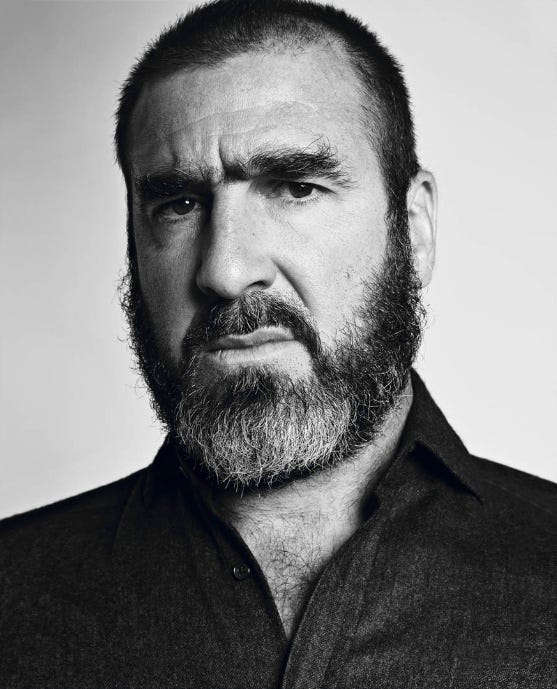
The character exists in the same strange territory as James Dean, Maradona or Muhammad Ali, where the public figure eventually becomes something that other people use to understand themselves.
That is a much bigger achievement than celebrity.
It is cultural permanence.
Why Cantona Survived
The 1990s are fashionable again.
People want the shirts, the Stone Island, the Umbro kits, the Britpop records, the old trainers, the grainy photographs.
Cantona survives this nostalgia because he was never merely a product of the decade.
He understood something permanent about celebrity.
People do not remember you because you were visible.
They remember you because you gave them an image they could not quite resolve.
Cantona was simultaneously aristocratic and working-class, French and Mancunian, intellectual and violent, vain and private, deeply competitive and capable of walking away from competition.
He could appear ridiculous and magnificent within the same five minutes.
He could kick a spectator and then speak like a surrealist poet.
He could wear Stone Island on television, appear on a Paco Rabanne runway, lead a Nike commercial against the Devil and then spend his evening watching an obscure film at the Cornerhouse.
None of these identities cancelled the others, they accumulated.
That is why the comparisons become interesting.
He had Morrison’s appetite for self-invention, Gallaghers’ refusal of respectable behaviour.
He had the casual’s obsession with clothing as coded information, the footballer’s competitive narcissism and the artist’s need to observe.
And, eventually, he developed the actor’s understanding of performance.
But he was never reducible to any of them.
The Art Of Being Untouchable
The most revealing thing about Eric Cantona is not that he became an icon.
It is that he understood the danger of becoming one.
Once the public decides who you are, every future version of you is measured against the first.
Cantona escaped that trap by leaving.
He left France, he left Leeds, he left football.
He left the expectation that he should behave normally. He left the identity of the footballer.
And every time he left, he created another version of himself.
The boy from Marseille became Manchester’s King.
The footballer became a fashion reference.
The fashion reference became a cinematic character.
The cinematic character became an actor.
The actor became an artist.
And underneath all of it remained the same instinct he had as a child watching his father paint: look harder, feel more, refuse the obvious interpretation.
He became untouchable because every time the world thought it had finally understood him, he changed the subject.

If you are interested in becoming a GUAP contributor and telling stories that matter to the culture we want to hear from you. We commission emerging writers, journalists and video creators every month to cover the people, communities and moments our audience needs to discover. Your subject. Your voice. No brief.
For more information/submit a story - click here.

Consider becoming a paid subscriber and gain access to:
The full GUAP Daily: five deep-dive articles/video essays written by and for the culture, a week straight to your inbox, Monday to Friday.
The Sunday opportunities newsletter - jobs, freelance roles, commissions, casting calls and industry openings every week
Monthly online events - masterclasses, workshops, live interviews and community gatherings ran by OURPPLS.
Discounts/Perks from our community partners including Tunecore,
For only £6 a month (price of a coffee) you get access to the opportunities, the knowledge and the community that keeps you close to the culture. Whether you are building something or you just care about what is happening - this is where you want to be. And every membership puts money directly into the hands of the writers and creators telling the stories that actually matter.