




For a while, Britain became obsessed with beautiful men.
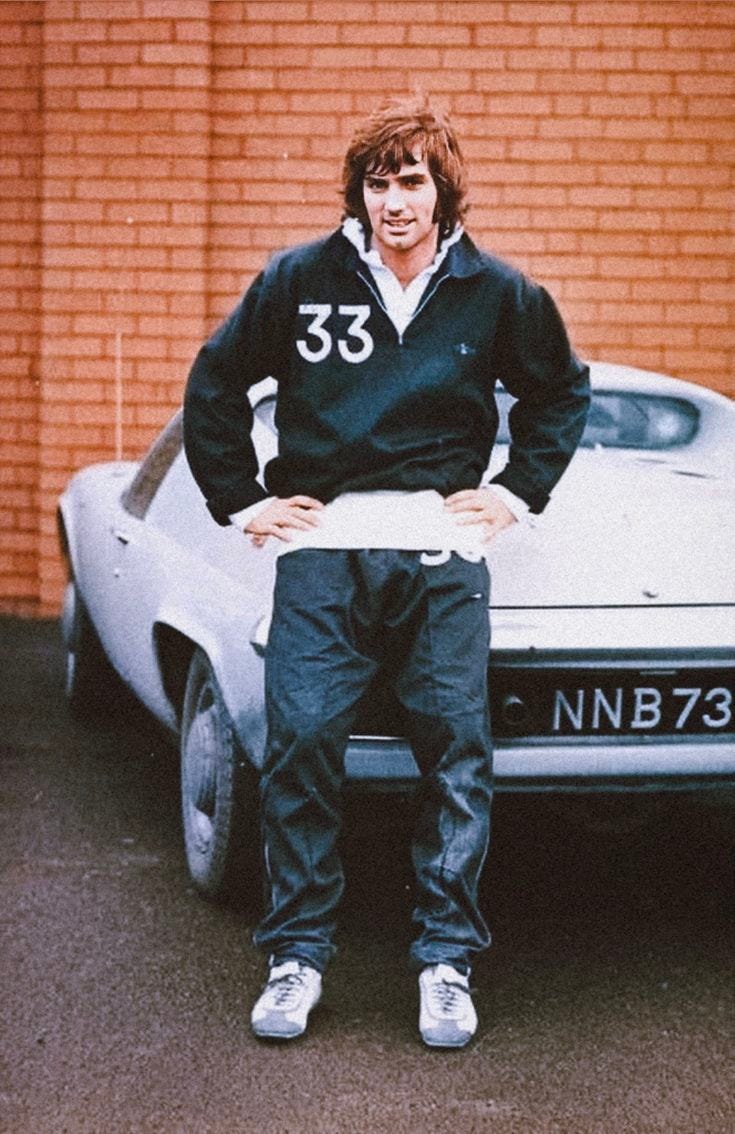
Not beautiful in the old way. Not the polished, distant kind that belonged to film stars in tuxedos or aristocrats in oil paintings. This was a new sort of beauty: skinny, insolent, slightly decadent. Hair falling into the eyes. Cigarette between fingers, tight trousers, boots, jewellery and a face that looked better photographed than explained.
The country was getting younger, and with that, considerably less interested in behaving.
The boys who had grown up during the war were now fathers with mortgages. Their sons had different plans. They wanted records, clothes, girls, cars, noise. They wanted to stay out. They wanted to look like somebody else. Carnaby Street was selling an idea of London that had very little to do with London itself. The boutique became a kind of theatre. You went in to buy a shirt and came out with an imaginary life.
Music had already figured this out. Football hadn’t. Well, not properly at least. Then, somehow, a boy from Belfast appeared, as if he’d wandered into the wrong industry.
He had a footballer’s feet and a pop star’s face. He could walk into a nightclub looking like a singer and walk onto a pitch looking like somebody had made a clerical error.
His name happened to be Best. George was almost an afterthought.
There is something faintly ridiculous about how perfectly the name worked. George Best.
It sounds invented. A stage name. A headline waiting to happen.
He was born in 1946 in Cregagh, east Belfast, into a working-class Protestant family. His father, Dickie, worked at Harland and Wolff. His mother, Anne, had been a talented hockey player. George was one of six children, a quiet boy with an appetite for football that was considerably larger than his appetite for school.
At fifteen, Manchester United scout Bob Bishop saw him play for Cregagh Boys and sent Matt Busby a telegram:
“I think I’ve found you a genius.”
The genius went to Manchester. Two days later, he went home, homesick.
It is one of those details that makes the whole story feel less preordained. We know what happens to George Best because history has made the ending impossible to miss. But the fifteen year old himself had no idea that his face would one day be on walls, that people would fly across the world to see him play, that strangers would discuss his sex life over breakfast, that his mother would become famous because of him, that his name would become a cultural shorthand for a particular kind of beautiful self-destruction.
He just wanted to go home. He was persuaded to return, but this time, he stayed and Manchester got its boy.
The first time Best became properly dangerous, it wasn’t because of anything he did with his hair, it was Lisbon. Manchester United went to Benfica in March 1966 and won 5-1. Best scored twice. He was nineteen. The Portuguese press called him the fifth Beatle.
People sometimes repeat this as though it were merely a charming nickname. It wasn’t. It was a cultural relocation.
The footballer had been moved into the territory of the pop star.
Suddenly the things surrounding the performance were available for consumption too. The face. The clothes, the girlfriend, the night out, the photograph, the haircut, the entire story.
You could have no particular interest in football and still know George Best. That was the trick.
The National Football Museum now describes him as arguably the world’s first true football superstar, and the distinction is useful. A football star belongs to football. A superstar belongs to everybody. Best was beginning to belong to everybody.
That was both his greatest success and the beginning of his problems.
The photographs from that period are almost offensively good.
Best in a polo neck. Best in a suit. Best with his hair falling over his forehead.
Best leaning against a car. Best with women etc. He had that rare quality of looking good while apparently doing nothing at all.
And then he would play. That was the part that made the rest dangerous.
If he had merely been beautiful, he would have become a minor celebrity. If he had merely been brilliant, he would have become a football legend. But He was both, even worse, he was funny also.
He was charming, he could be shy, he could be rude, he could be extremely generous, he could also be a complete bastard.
The contradictions weren’t a flaw in the story, they were the story.
People sometimes talk about Best’s fashion as though he simply wore nice clothes.
He didn’t. He dressed like a man who had discovered that his body was another piece of media. Sharkskin suits. Polo necks. Medallions. Cuban heels. Chelsea boots. Hip-huggers. Suede. Jewellery. The famous Jaguar. The clothes were part of the silhouette and the silhouette was George.
The Guardian’s history of football and fashion describes him as the patron saint of footballer style and recalls the moment that Best and Manchester City winger Mike Summerbee opened a boutique together. The boutique was called Edwardia.
This is one of those facts that feels almost too perfect to have actually happened.
Two footballers, from rival Manchester clubs, opening a fashion shop while still playing.
Today it would barely raise an eyebrow, at the time it was outrageous enough to feel futuristic. Best wasn’t waiting for football to give him permission, he had already wandered off.
There was money in it, obviously, but money isn’t quite the interesting part.
The interesting part is that Best discovered how quickly a person’s face could become an object of commerce.
He endorsed products. He appeared in catalogues. He had a boot deal with Stylo reportedly worth £20,000, a considerable sum in the late 1960s. He was turning up in advertisements because he was George Best. Not because he had developed some expertise in whatever was being advertised.
This sounds normal now because we live in a world where a footballer’s breakfast can have a sponsor. The strange thing is that he didn’t seem particularly interested in becoming an empire.
He wanted the good things in life, he was not collecting money. He was spending it on being alive!
That distinction becomes increasingly important the further into the story you go.
His house was called Que Sera. Doris Day. Whatever will be, will be.
He had heard the song during childhood holidays with his maternal grandfather, George Withers, and later gave the name to his house in Bramhall. His friends, the loose collective known as “The Chaps,” would gather there on Sundays to drink, watch television and talk about everything from politics to religion.
I like this detail because it makes the lore smaller.
Que Sera is not a nightclub, it is a house. There is a George Best in the public imagination who never sits down. He is always arriving somewhere. Always leaving somewhere. Always holding something. Always surrounded.
The George Best at Que Sera could apparently spend a Sunday talking about religion.
He could sit with Bobby Charlton and ask how much his carpet cost.
He was apparently very good at cryptic crosswords. He watched University Challenge.
The Guardian’s review of Duncan Hamilton’s biography describes this oddly domestic side of him, including Best’s questions about Charlton’s cleaner and the cost of his carpet.
There is something almost hilarious about it. George Best, serial tabloid fantasy, thinking about carpets.
That is the kind of detail that survives a biography because it refuses to fit.
Good. Let it refuse.
The public had decided he was a playboy.
The private man was stranger. He was reportedly shy. He could be intensely private.
He could become lonely despite being surrounded by people.
Rosalyn Hollidge, who was close to him later in his life, remembered watching Mastermind and University Challenge with him and described his ability with cryptic crosswords. She also said his drinking worsened when he was alone.
There is a photograph of George Best that doesn’t exist. The one where he’s not performing.
One where he is not smoking, drinking, being a bad boy. Just sitting somewhere on an ordinary Tuesday with nothing particularly interesting happening.
That might be the person we know least because the public George was spectacular.
And spectacular people have very little privacy.
The cameras followed him, the newspapers wanted him.
Women wanted him, men wanted to be him.
Clubs wanted him at their tables, brands wanted his face.
His family got dragged into it.
His mother, Anne, eventually developed an alcohol dependency and died from alcohol-related heart problems at fifty-four. She had been teetotal for most of her life. Accounts of her decline describe the pressure of George’s celebrity and the relentless attention around the family.
This is the part that makes the glamorous photographs feel slightly poisonous.
George left Belfast, but the fame didn’t, instead, it came back to the house. It came through the letterbox and it sat in the family kitchen, and worst, It followed his mother around.
The fantasy had consequences for people who hadn’t volunteered to participate.
And George was not innocent inside the fantasy. That matters too.
It would be very easy to turn him into a tragic little prince destroyed by fame, but that would be another lie.
He liked it. He liked women. He liked clothes. He liked drinking.
He liked the life he had built. There is a wonderful perversity in that.
The world did not force George Best to become George Best, George Best kept giving the world material.
Then the world kept asking for more.
He was twenty-one when Manchester United won the European Cup in 1968.
Twenty-one.
Bobby Charlton scored twice in the final against Benfica. Brian Kidd scored the other. Best scored too.
The image of the three of them is almost unbearably good.
Charlton, the dignified one, Law, the hard-edged one, Best, the beautiful one.
Except that Best was not merely beautiful, he was extraordinary.
That is what makes the whole thing difficult.
The glamour was not a distraction from the football, The football was ridiculous!
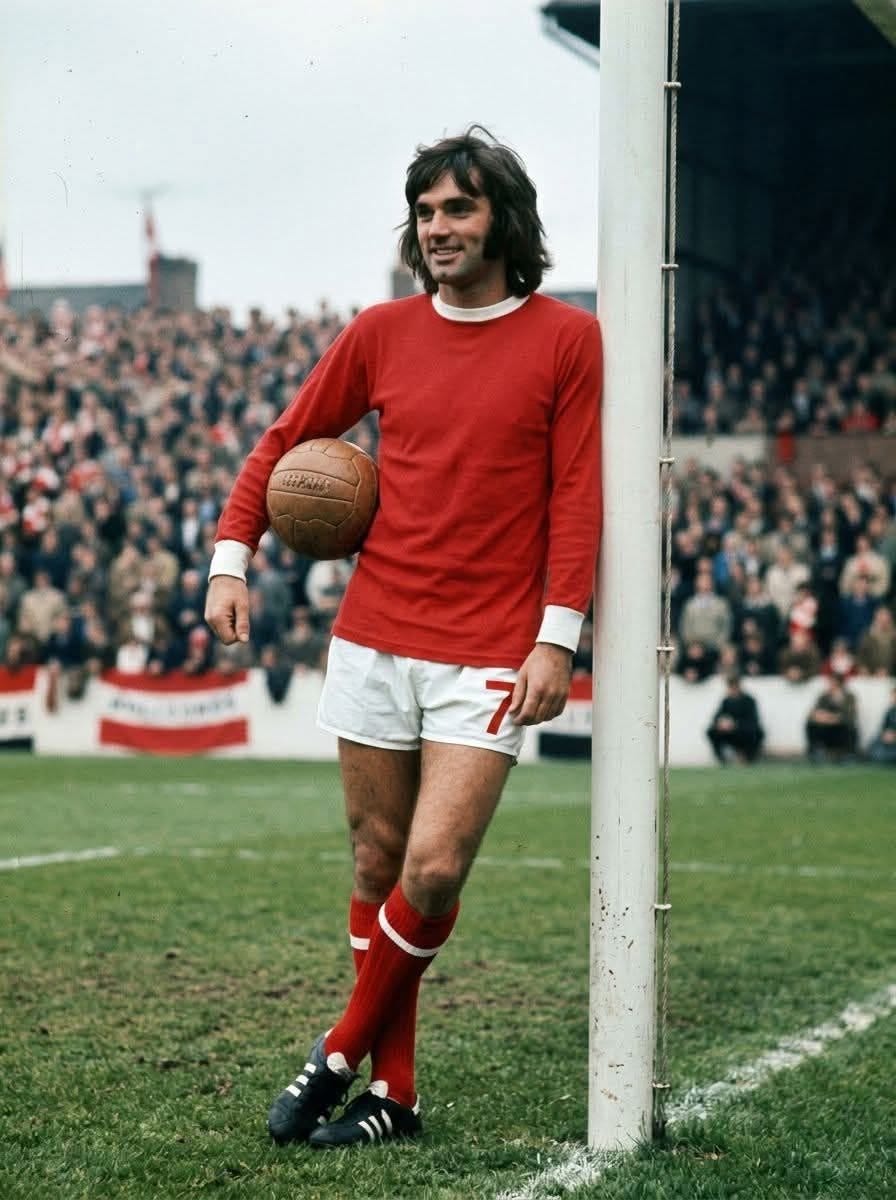
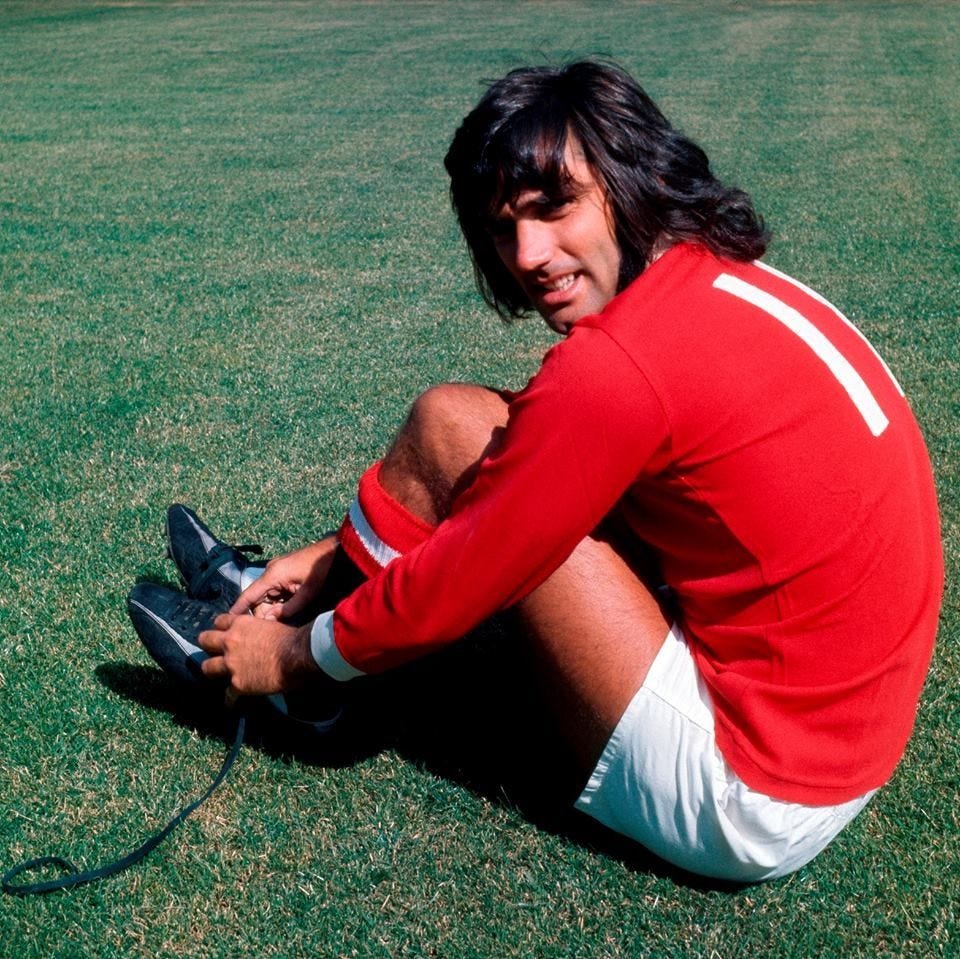
He could beat defenders from either side. He could carry the ball through crowds. He had a strange, almost delicate balance that made physical contact look temporary. He wasn’t especially big or obviously muscular. Watching him now, he looks almost too thin to survive the tackles.
Then somebody touches the ball near him and the whole frame changes.
This was not a model who happened to play football, this was a footballer who happened to look like a model. The distinction is everything.
And then there is the sex.
You cannot write about George Best without writing about sex because sex was not a side note to his celebrity, it was part of its grammar.
He became one of the first footballers whose desirability was openly discussed as part of his public identity. Women surrounded him and models appeared beside him.
The press documented his relationships. His face was photographed as much for its sexual appeal as for his sporting ability.
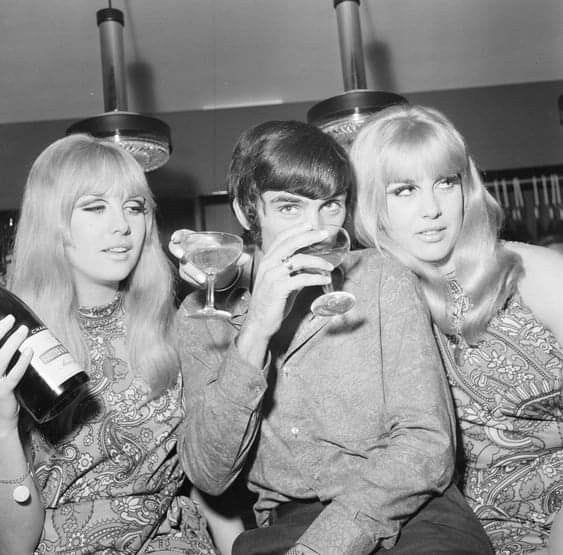
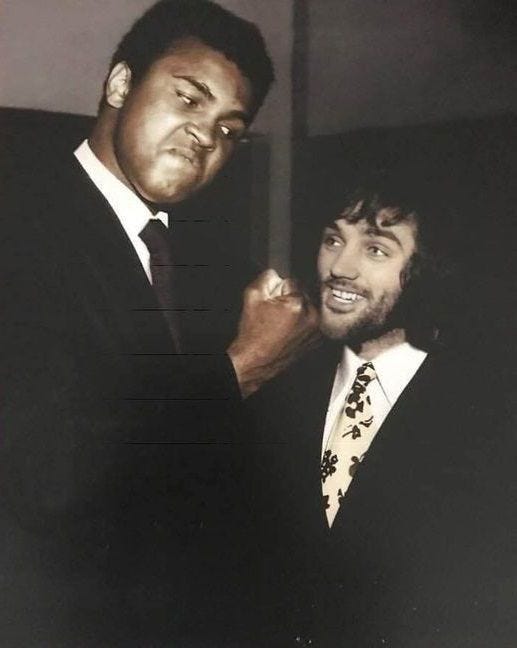
Elizabeth Taylor became fascinated by him. In a 1972 Observer piece, she spoke about her sympathy for Best during the troubles surrounding his life and recognised something familiar in the machinery of celebrity. She knew what happened when a young person’s face became public property.
That is a bizarre pairing. Elizabeth Taylor and George Best. Hollywood and football.
But culturally, they make perfect sense. They were both living inside the same new economy of beauty.
A face could open doors and sell things, it could make people curious. It could also make people forgive you. It could also make people feel entitled to you. We call this nowadays marketing and PR.
Best was not the first beautiful man.He was one of the first beautiful men in football who became famous for being beautiful. That difference is worth sitting with.
Football had traditionally offered a particular masculine fantasy: strength, discipline, toughness, victory.
Best added vanity. He added clothes alongside sexual charisma.
He added the possibility that a footballer could be looked at in the same way a singer or actor was looked at.
And he did it without becoming less masculine.
Quite the opposite. The beauty became part of the power. That is one of his most lasting cultural effects.
The footballer could be a beautiful object and still be the most dangerous man on the pitch.
The modern footballer inherited this without necessarily knowing it.
Beckham is the obvious descendant. Then Ronaldo. Then Neymar.
Then the endless parade of players arriving at stadiums dressed for photographs rather than weather.
The difference is that all of them entered an established system.
Best didn’t. He was wandering around before anyone had put up the signs.
There was no Instagram, no personal stylist, no luxury brand ambassador programme or social media manager checking whether the photograph looked “on brand.”
There was just a young man with taste, money, a face people couldn’t stop photographing and a growing suspicion that the world was quite fun if you didn’t think too hard about tomorrow.
That last part is important.
Because football had taught him that instinct worked and it really did. That was the terrifying thing. He was usually right.
The defender moved. He beat him.
The goalkeeper came out. He chipped him.
A gap opened. He took it.
At twenty-one, he had a European Cup medal and a Ballon d’Or. Imagine the psychological reinforcement of that! Every time you trusted yourself, something happened.
Why would you suddenly decide to become cautious?
His career at Manchester United ended when he was twenty-seven.
That sentence is still insane. Twenty-seven. He had already done enough to become immortal.
He had also begun missing matches, drinking heavily and allowing the life around football to become more important than football itself.
He played in America, at Fulham, Hibernian, San Jose and elsewhere.
There were flashes. Always flashes. That might be the cruelest part. The talent did not leave him cleanly. It came back at inconvenient moments. He could still make a footballer look stupid or produce a goal. He could still remind everyone why the whole thing had started.
Then the night would come back hand in hand with the drinking, newspapers and ultimately the next version of George Best.
This is something I love about Best. He was not even a reliable witness to his own legend.
Different versions of famous anecdotes changed depending on who was telling them, where the event supposedly happened, how much money was involved, who was supposedly in the room. Biographer Duncan Hamilton spent years interviewing people around Best partly because so many of the stories had mutated over time.
Of course they did. George Best was exactly the kind of person around whom stories would reproduce. Most of these versions contain something true, but none of them contain all of him.
That is what makes the title work. Everybody knew the Best. But which one?
The saddest thing about George Best may not be that he drank himself into ruin.
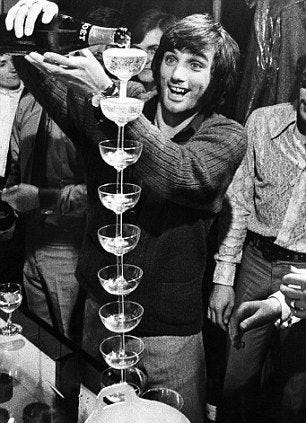
It may be that he became famous before he had developed the luxury of being boring.
He was never really permitted to become ordinary. Even his quietness became interesting.
Everything was content before content had been invented. And once a person reaches that level of visibility, disappearing becomes almost impossible.
There is a photograph from 1967 of Best celebrating the opening of his boutique, champagne around him, surrounded by people. He looks young enough to be somebody’s younger brother.
That is perhaps the strangest thing about the whole story.
He was. He was somebody’s son, somebody’s brother. A boy who missed home.
Then the face, the name and body became famous while the football became immortal.
And the private person had to live somewhere underneath all of it.
George Best died in London in 2005 at fifty-nine.
By then, the photographs had been circulating for decades. His name had become almost impossible to separate from the idea of excess.
But before all of that, before Beckham, before Instagram, before footballers became fashion properties, before athletes had stylists and creative directors and entire teams dedicated to making them desirable, there was a young man from Belfast who walked into a changing culture and looked completely at home.
Not because he had planned it or because he was trying to invent anything.
Because, for a brief and ridiculous stretch of time, the world looked exactly like the place he wanted to be.
And everybody wanted to come with him.
Everybody knew the Best.
George.

If you are interested in becoming a GUAP contributor and telling stories that matter to the culture we want to hear from you. We commission emerging writers, journalists and video creators every month to cover the people, communities and moments our audience needs to discover. Your subject. Your voice. No brief.
For more information/submit a story - click here.

Consider becoming a paid subscriber and gain access to:
The full GUAP Daily: five deep-dive articles/video essays written by and for the culture, a week straight to your inbox, Monday to Friday.
The Sunday opportunities newsletter - jobs, freelance roles, commissions, casting calls and industry openings every week
Monthly online events - masterclasses, workshops, live interviews and community gatherings ran by OURPPLS.
Discounts/Perks from our community partners including Tunecore,
For only £6 a month (price of a coffee) you get access to the opportunities, the knowledge and the community that keeps you close to the culture. Whether you are building something or you just care about what is happening - this is where you want to be. And every membership puts money directly into the hands of the writers and creators telling the stories that actually matter.