



He was born in Setúbal in 1963, the son of Félix Mourinho, a professional goalkeeper who later became a manager. José tried playing himself, but the career never arrived. He studied sports science, took coaching courses, worked with young players, and eventually found himself beside Bobby Robson at Sporting Lisbon. His official job was translation.
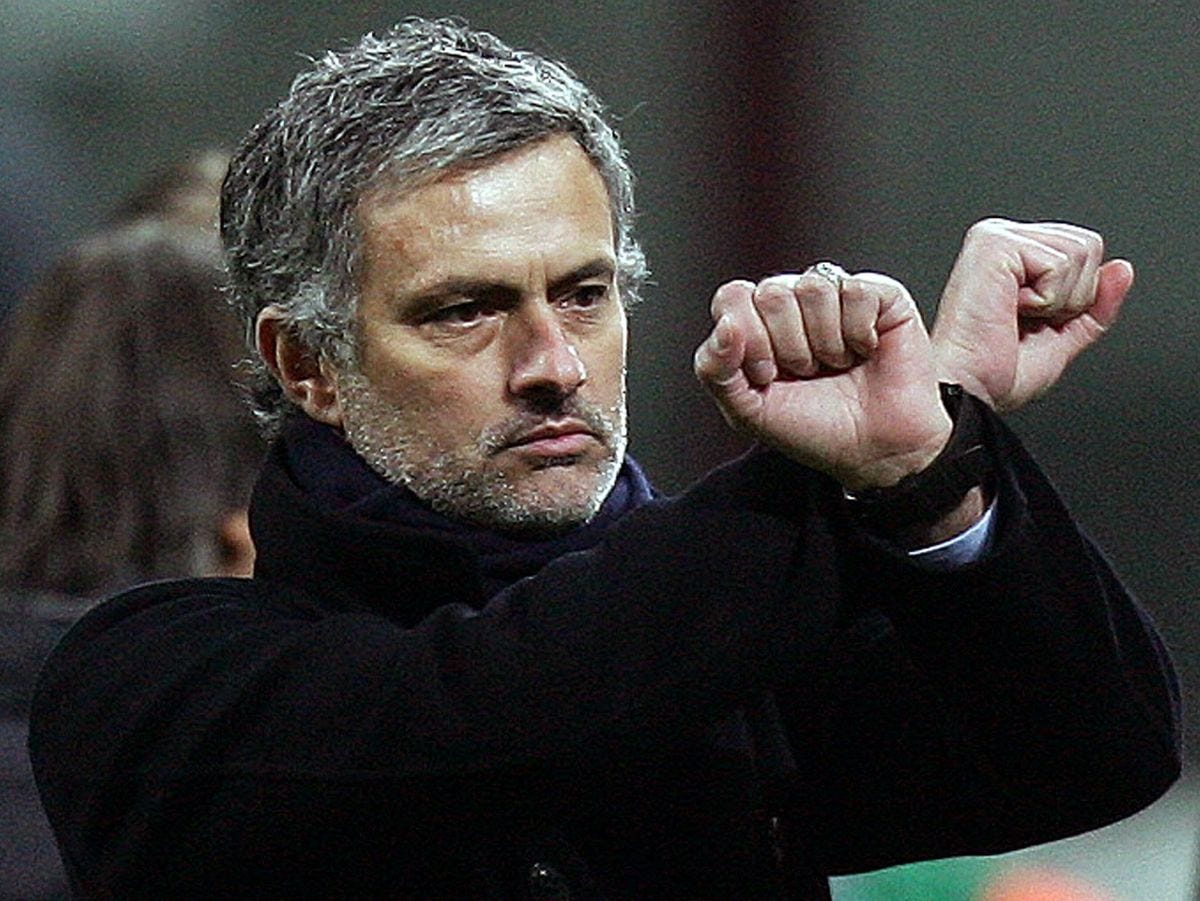
It is one of those details that sounds almost too neat in retrospect. The future José Mourinho, the man who would eventually make press conferences feel like heavyweight contests, started his career listening to somebody else speak.
Robson took him to Porto and then Barcelona. At Barcelona, Louis van Gaal arrived and kept Mourinho close, eventually giving him responsibilities far beyond translation. Mourinho learned how managers spoke to players, how they prepared opponents, how they built authority, how information moved through a dressing room. He was watching football from the inside without being the person everybody was watching.
That position probably mattered more than the word “translator” suggests.
A translator has to listen for things that aren’t literally being said. Tone. Hesitation. What somebody means when they choose one word instead of another. Which part of a sentence matters. Which part should disappear.
Mourinho would eventually turn that into a managerial skill.
He also learned something less technical. Football is full of people trying to control the room.
The chairman. The manager. The captain. The star player. The journalists. The supporters. The referee. The opponent. Everybody is telling a version of the story.
Mourinho simply became unusually interested in who got to tell it.
His first serious managerial job came at União de Leiria. Then, in January 2002, Porto hired him. Eighteen months later he had won the Portuguese league, Portuguese Cup and UEFA Cup. A year after that, Porto were European champions.
The famous image came in between.
Manchester United had just been eliminated in the Champions League. Porto had scored late at Old Trafford. Costinha put the ball in and Mourinho sprinted down the touchline, arms out, black coat flying, looking less like a coach celebrating qualification than somebody who had just escaped from a burning building.
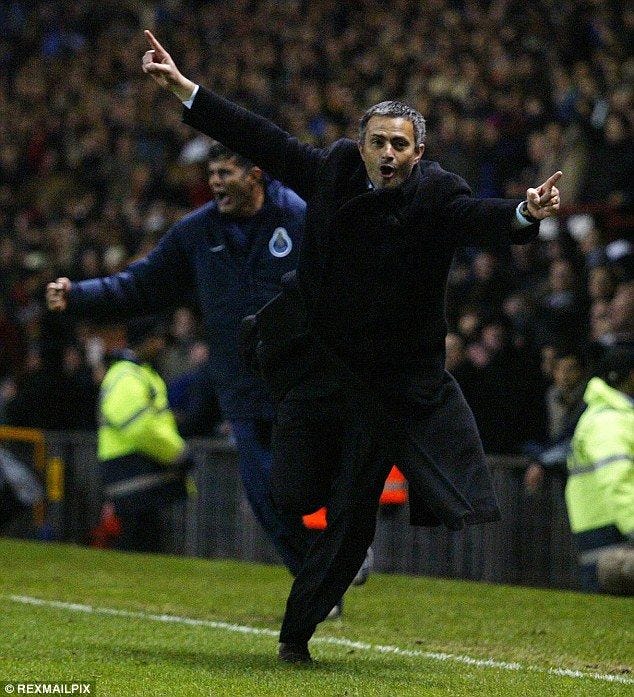
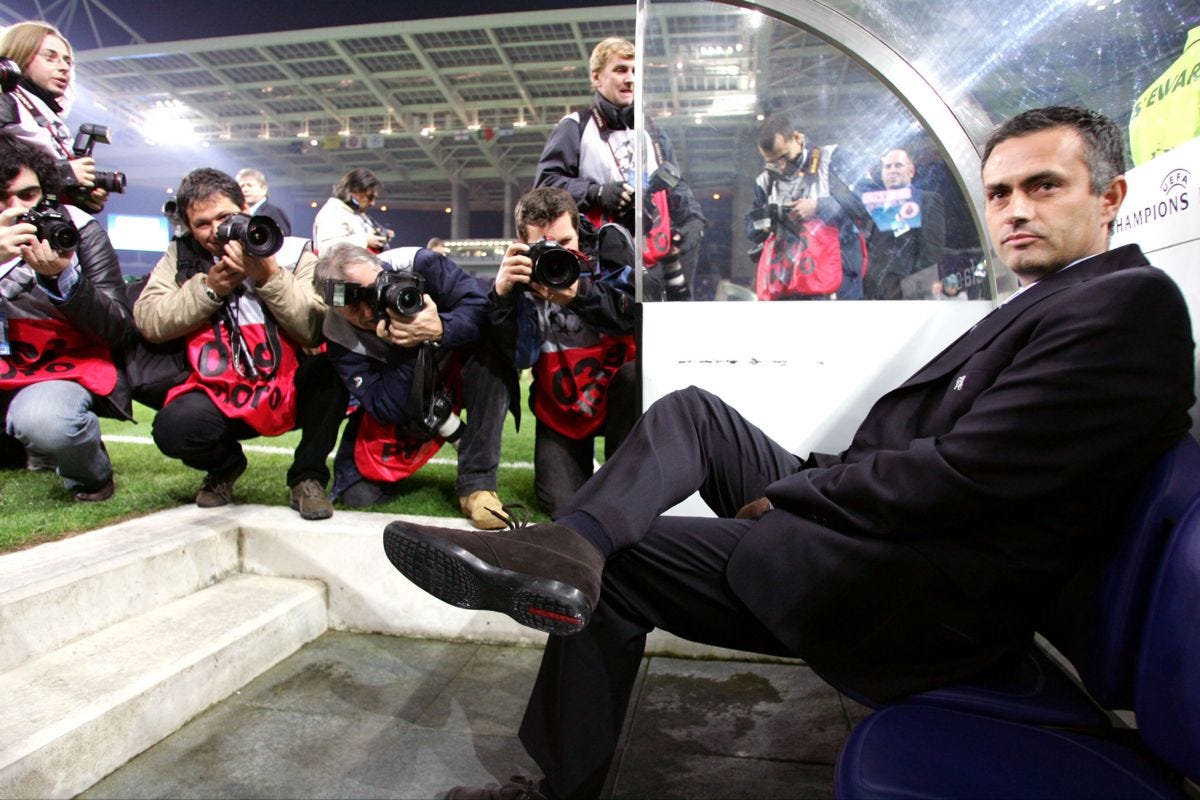
The picture mattered, and Mourinho understood pictures.
When he arrived at Chelsea in 2004, he walked into his first major English press conference and introduced himself with the line that would follow him for the rest of his career: “I think I am a special one.”
It was funny because it was outrageous. It was effective because he said it before anybody else could decide what he was.
The phrase became a nickname. The nickname became a character. The character became part of the job.
That is the strange thing about Mourinho. His personality was never decoration around his football. It was one of his working tools.
At Chelsea, he did not simply tell his players they could win. He created an atmosphere in which winning became socially expected. He talked about being able to “smell success” at the club before Chelsea had actually won the league.
That sounds like theatre until you understand what theatre can do.
A dressing room is a small society. People take cues from one another. Confidence is contagious, but so is doubt. Mourinho was very good at manufacturing the former and giving the latter somewhere else to live.
The 2004/05 Chelsea team conceded just 15 league goals. They won the Premier League with a defence that seemed almost insultingly organised. Mourinho’s football was often described through the language of pragmatism, but there was something more interesting happening. He was trying to reduce randomness.
Training sessions were built around situations. Players were shown video of their own performances. Opponents were dissected. Individual responsibilities could be extraordinarily specific. UEFA described his approach at the time as unusually scientific, including his use of video analysis and specialist preparation.
He did not want football to remain mysterious for his players, he wanted them to know what was coming.
This is probably why Mourinho’s press conferences were never quite separate from his tactics. They were another form of preparation.
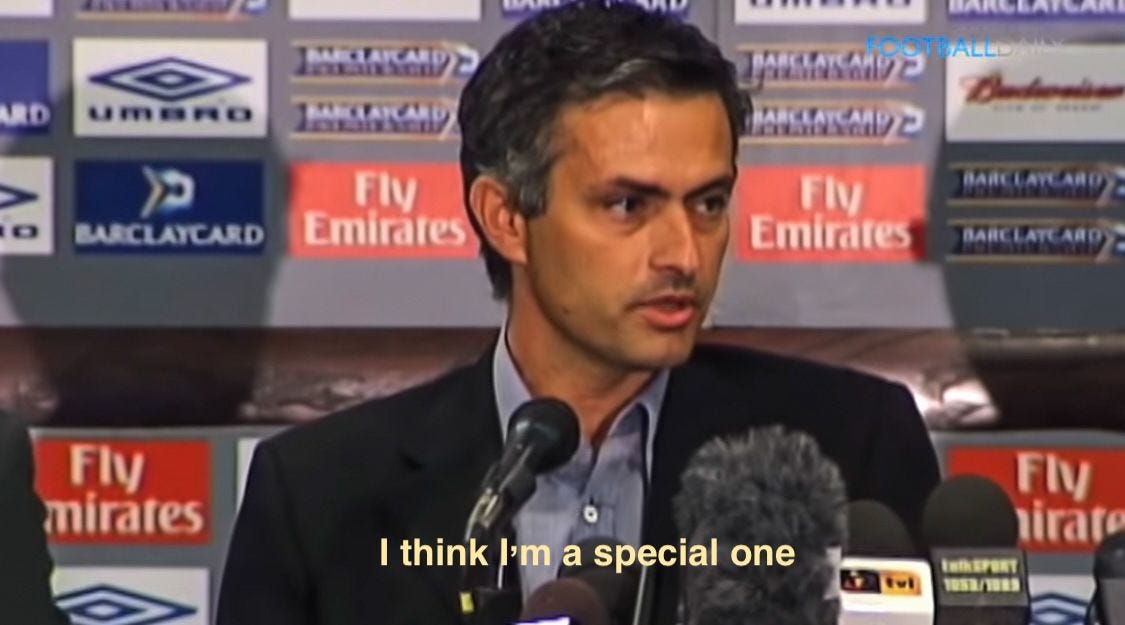
He could praise an opponent, irritate a referee, protect a player, provoke a rival manager or create a siege mentality without ever needing to draw a formation on a board.
He understood that a football match begins long before the players walk onto the pitch.
Sometimes it begins with a sentence.
His genius, when it worked, was making other people react to the sentence he had chosen.
There was a slightly old-fashioned quality to this. Mourinho dressed like a man who understood that clothes communicate rank. Dark suits. Coats. Watches. Sunglasses. The carefully controlled touchline silhouette. He never looked accidental.
This was before Instagram turned managers into lifestyle, but unlike a footballer selling a watch or a pair of trainers, Mourinho’s product was authority itself. He was selling the idea that he knew.That distinction became especially useful whenever his teams were under pressure.
At Porto, he could build himself into the leader of an outsider. At Chelsea, he could turn a club desperate for its first league title in half a century into a machine that expected the title. At Inter, he could convince an experienced squad that Europe was something they were capable of taking back. In Madrid, Manchester and later elsewhere, the calculation became harder because Mourinho was no longer arriving as the outsider who had something to prove, he was arriving as Mourinho.
That changes the psychology of the room.
The 2010 Champions League semi-final against Barcelona is probably the clearest example of how far his football could go when the circumstances demanded it.
Inter won the first leg 3-1 in Milan. In the return at Camp Nou, Thiago Motta was sent off in the first half. Inter played for more than an hour with ten men against Barcelona, defending their aggregate lead while Barcelona circulated the ball around them. Mourinho’s players blocked, retreated, covered spaces and absorbed pressure until Gerard Piqué scored late. It wasn’t enough. Inter went through 3-2 on aggregate.
Mourinho sprinted onto the Camp Nou pitch afterwards. Again, the image became part of the football.
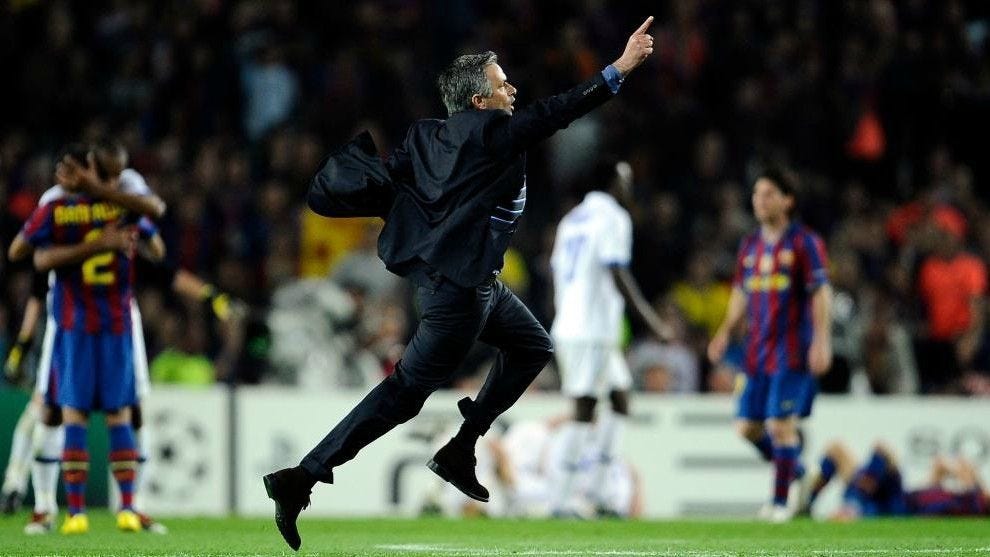
But look closer at what actually happened: he had taken the game and made it smaller.
Barcelona wanted space. Mourinho gave them almost none. They wanted rhythm. Inter interrupted it. They wanted the match to become a demonstration of their superiority. Mourinho turned it into a problem to be solved.
That Inter side eventually won the Champions League, Serie A and Coppa Italia treble.
Mourinho had not discovered some secret formula for beautiful football or ugly football.
He had discovered something more useful, how to make a match feel like his kind of match.
This is where the Guardiola rivalry becomes interesting without reducing it to the usual football-manager soap opera. Guardiola’s Barcelona represented a very particular faith in the ball: possession as control, circulation as territory, technique as authority.
Mourinho was interested in everything surrounding the ball.
The referee. The crowd. The emotional temperature. The opponent’s habits. The press. The little grievance that could make eleven players run five percent harder for each other, he treated football as an ecosystem; and, sometimes, he seemed almost fascinated by the people watching it.
His press conferences could become miniature psychological experiments. He would pause. Refuse a question. Give too much information. Give none. Praise someone suspiciously. Say something ridiculous with a completely straight face.
“I prefer not to speak” became one of his most recognisable phrases because it was almost a joke about the machinery itself. Journalists needed him to speak. Mourinho understood that refusing to speak could become another kind of statement.
There is something slightly strange about how much of modern football already resembles Mourinho.
Managers are now photographed arriving at training. Players have personal brands. Every post-match sentence is clipped, reposted and analysed. Touchline behaviour becomes content. Coaches are expected to have an opinion on everything.
Mourinho helped create the environment in which this became normal.
He understood earlier than most that the manager could become a cultural figure independent of the players.
Not just the man drawing arrows on a tactics board, but the man whose coat people noticed, whose facial expression became a meme, whose argument with a referee could become tomorrow’s front page.
And yet there was always a danger in being that person.
The character requires maintenance and the room eventually knows your tricks.
The siege mentality that can make a team feel invincible can also exhaust it. The constant confrontations, public battles and emotional pressure that once made Mourinho’s teams feel bonded could eventually become part of the burden. His career contains several cycles in which extraordinary success is followed by tension and collapse. That pattern is real, although it is too simple to turn it into a universal law about his teams.
The fascinating part is that Mourinho never really abandoned the method.
Even when the football changed, the instinct remained.
Control the environment, control the information, control the emotional temperature, control the story.
Maybe that is why the word “theatre” belongs here. Not because Mourinho’s football was fake. Quite the opposite. The football was often brutally concrete. The theatre was everything around it.
The entrance. The clothes. The timing. The press conference. The enemy. The quote. The celebration. The silence afterwards.
He understood that winning does not happen in a vacuum. It happens in front of people, inside institutions, under cameras, with egos involved.
And Mourinho has always been fascinated by the human machinery of it. That may be the most revealing thing about the man who began as somebody else’s voice, he eventually became one of football’s loudest.
But his real education happened before anyone was listening to him, he spent years standing beside the manager, translating the words. Then he started studying the room and after he started controlling it.
And eventually, almost without anyone noticing exactly when it happened, the room became part of José Mourinho’s football.

If you are interested in becoming a GUAP contributor and telling stories that matter to the culture we want to hear from you. We commission emerging writers, journalists and video creators every month to cover the people, communities and moments our audience needs to discover. Your subject. Your voice. No brief.
For more information/submit a story - click here.

Consider becoming a paid subscriber and gain access to:
The full GUAP Daily: five deep-dive articles/video essays written by and for the culture, a week straight to your inbox, Monday to Friday.
The Sunday opportunities newsletter - jobs, freelance roles, commissions, casting calls and industry openings every week
Monthly online events - masterclasses, workshops, live interviews and community gatherings ran by OURPPLS.
Discounts/Perks from our community partners including Tunecore,
For only £6 a month (price of a coffee) you get access to the opportunities, the knowledge and the community that keeps you close to the culture. Whether you are building something or you just care about what is happening - this is where you want to be. And every membership puts money directly into the hands of the writers and creators telling the stories that actually matter.