





I know we all recall the strange reality of 2020: the sudden uncertainty, the closed doors, the (very needed) social distancing, and the moment many of us realised our usual beauty routines were no longer accessible. For textured hair consumers like myself, lockdown created an unusual challenge — our relationship with salons, stylists and professional guidance was interrupted almost overnight.
So, what did we do? We went back to the drawing board. Recipes passed down through generations became our staples, and social media platforms like YouTube, TikTok and Instagram became our new salons — a place to share, connect and spread knowledge on how to care for our hair at home.
Fast-forward to 2026 — technology has advanced, and social media has become our ultimate go-to for everything under the sun, birthing a new wave of hair gurus and critics — everyone has an opinion! Brands changed strategies, products launched, all claiming to be science-backed and evidence-led. But how has this constant access to information and shift in the industry transformed our buying behaviour? In a market saturated with endless product drops and clinical jargon, I’m trying to figure out the true cost of a curl — is it just financial, or is it tied to the mental toll of filtering out the noise? This structural tension poses a new question: Has independent, personal knowledge become the ultimate luxury in a space designed to keep us guessing?
In this article, I explore how textured hair consumers, including me, are navigating a beauty landscape shaped by money, identity, technology and information overload. Because the biggest question facing us now isn’t just what product should I buy? — it’s how do I know what actually works for me?
The Price of Conformity: Financial Deficits and Desirability Politics
It’s no secret that the rising cost of maintaining our hair is at an all-time high. Products, styling and general upkeep are slowly draining our pockets — and for textured hair consumers, the cost of looking after our hair can sometimes feel never-ending.
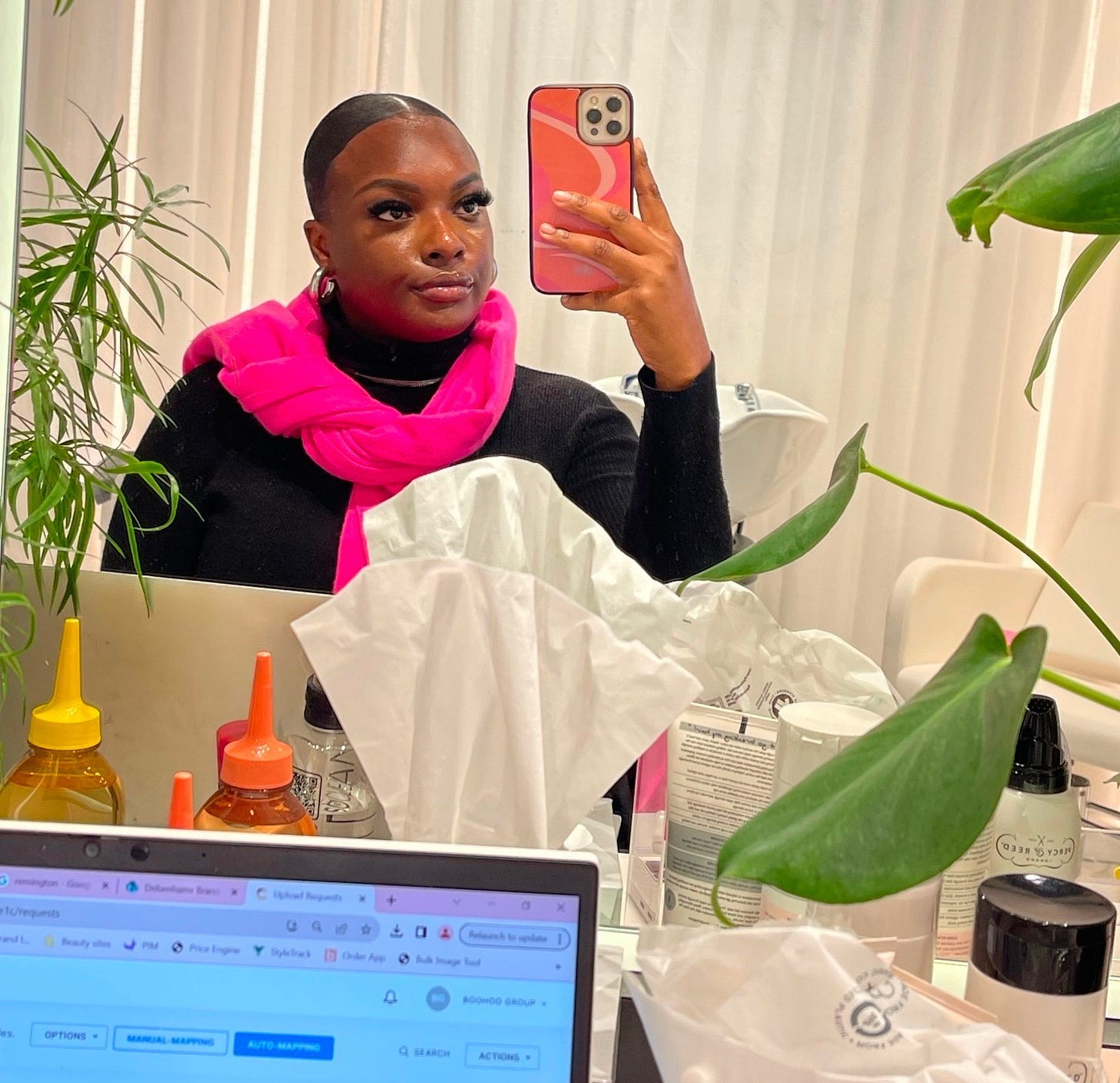
During my time as a Beauty Buying Assistant, I had the amazing opportunity to see first-hand just how much product exists within the beauty world. Looking back, moving into haircare was honestly a dream come true. I got to speak directly with brands about new launches, hear all the claims behind their latest “wonder products”, and understand the science and storytelling that went into convincing consumers why they needed them — and I won’t lie… I was completely sucked in. Launch after launch, event after event, I was in beauty heaven! Samples would land on my desk, products would be gifted, and I could experiment with different formulas without really thinking twice.
But then something hit me — I wasn’t actually buying these products with my own money…
Most, if not all, of the haircare products I accumulated during my time there were gifted. There was no real financial cost attached to my curiosity. I could try the latest treatment, the newest shampoo or the viral product everyone was talking about without having to think about the impact it would have on my bank account.
Fast-forward to now, and in a completely different field, I no longer have the luxury of trying a new product every other day. Once all the remaining product had been given away or used, I too began feeling that pinch. EVERY purchase now requires a little more thought.
“Do I actually need this? Will it work for my hair? Am I buying this because it’s genuinely beneficial, or because I’ve been convinced that I need it?”
And that’s when I started to dig deeper.
Because if I — someone who has worked within the beauty industry and has had access to education, products and conversations with brands — can still feel overwhelmed by the amount of choice available, what does that look like for everyone else?
Jamelia Donaldson, founder of TreasureTress, whom I had the absolute pleasure of meeting at a beauty event, has produced an incredibly important piece of research focusing specifically on Black consumer behaviour and textured haircare.
What immediately stood out to me from the TreasureTress Trend Report was a demographic disconnect that, although not entirely surprising, says a lot about the relationship between textured hair consumers and the industry.
“Black British women account for a staggering 10% of the UK’s total haircare spend, despite making up just 2% of the adult population.”
Now, me personally, I consider myself to be a DIY girlie through and through! There’s just something so rewarding about successfully recreating a look I’ve been wanting to try or mixing together my own natural-based concoctions. I started braiding my own hair in secondary school too, simply because my mum didn’t have the time or the expense to take me to the salon every time I wanted a new style, and I also wasn’t the best customer — if I hated my hair, believe me, I was taking it out the same day.
Being young, I was notoriously expressive with my hair. I dyed it, shaved it (thanks, Rihanna), braided it, slicked it — whatever you could think of, I did it. It was very much giving, “If someone else could do my hair, then I could do it too.” And because I understood my face shape and my features, over time I quickly learnt which styles suited me and which didn’t. So, often, going to a salon wasn’t my first point of call.
As a result, my personal expense when it comes to hair maintenance is considerably lower than some of my friends. Some of them have intricate styles like locs, so naturally they were exposed to the salon from an early age, requiring them to keep up with maintenance and keep those locs looking beautiful. Others just don’t enjoy doing their hair altogether and actually enjoy the ritual of someone else taking on the labour so they can sit back and relax — footing the bill after.
Neither approach is wrong — but it does highlight just how differently the cost of maintaining textured hair can look depending on how much time, knowledge, skill and access you have.
Interestingly, there’s been a major shift in the practice of hairdressing culture, and there’s equally been an increasing amount of conversation online around the experience of booking independent hairstylists, particularly those specialising in the styles that have dominated the textured hair spaces across social media recently — from wig and sew-in installs to silk presses, braids and natural hair styling. Many independent stylists have refined their craft and built successful businesses around these services, and rightly charge prices that reflect their time, expertise and demand.
At the same time, there’s an ever-growing conversation among consumers about the experience that comes alongside those prices. We’ve all seen the social media discourse: customers sharing stories about inconsistent service, perceived differences in how regular clients and influencers are treated, strict cancellation policies, deposits and late fees, or stylists cancelling appointments themselves with little notice. Of course, this isn’t a total reflection of every independent stylist, and there are plenty of talented professionals providing a top-tier service. However, the conversation itself reveals how consumers assess whether the overall experience feels worth the hassle.
And perhaps the most telling part of all of this is that some of us are heading back to the very women who started this whole thing: the traditional “aunties.”
The aunties never disappeared. They’ve adapted. They’ve learnt the trending styles, sharpened their skills and found themselves occupying a sweet spot in the market. They’re able to offer accessibility, flexibility and familiarity, often without the long list of terms and conditions that can sometimes make independent salon experiences feel incredibly painful. There’s something uniquely valuable about the service they provide. An independent stylist may charge separately for each stage of a multi-part routine or increase prices depending on length — most of the time, the final bill doesn’t include washing or treating a client’s natural hair — but aunties often provide a much more comprehensive service — washing, cutting, styling and finishing your desired look as part of one affordable package.
Community stylists shouldn’t just be considered as the “cheaper option” but as an integral part of an informal economy and community ecosystem.
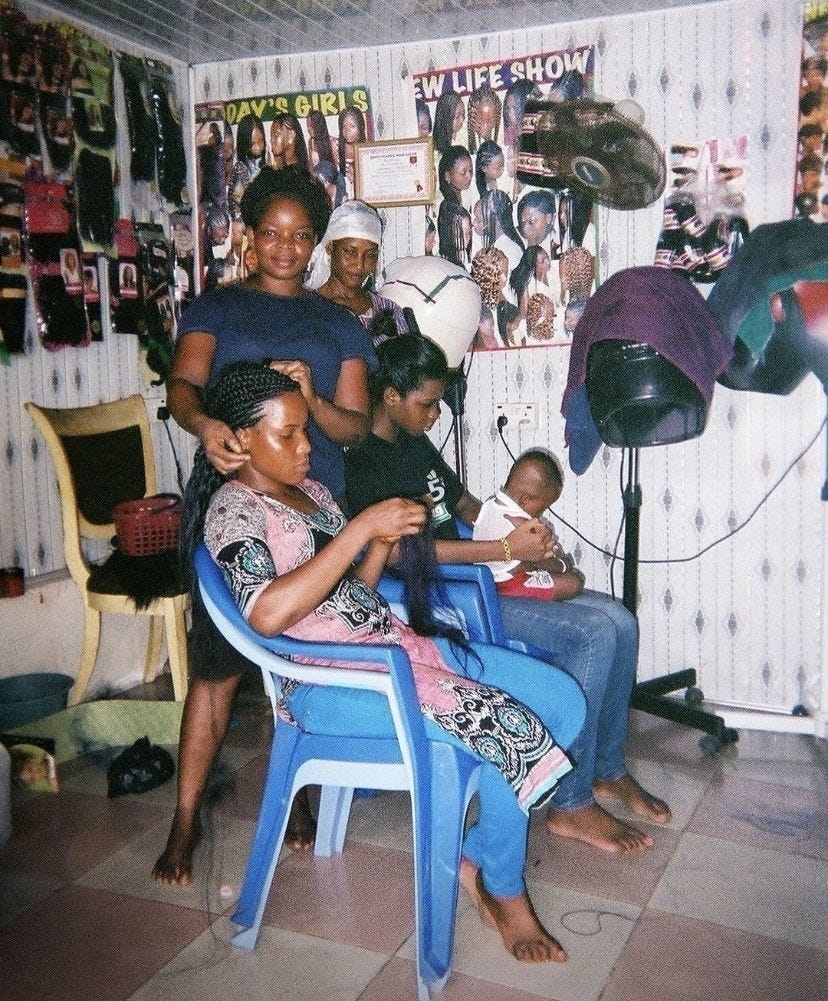
For consumers like me, that difference matters. Because when you’re already trying to work out where your money is best spent, paying for a service isn’t just about the final hairstyle. It’s about whether you’re getting value, care and an experience that makes you feel like your money was well spent.
I’ve always been someone who frequently enjoys styling my own hair. When I’m over it, though, I’ll stick it out and take on the 4-day conquest to do my own braids, or I might just locate my 26-inch 5x5 lace wig and call it a day. Between dealing with a sensitive scalp and managing my fine hair, daily styling doesn’t give me too much grief. A slick pony can take me less than 10 minutes to do (on a good day). Keeping it casual, I can opt for a shorter-length extension for work — very respectable, very demure — however, I can always go for a longer length for the club! It’s a style that works incredibly well for me.
A twist-out for some women might be the perfect low-maintenance style — one that somehow gets better as the week goes on. For others, it might be braids or locs, allowing for longer periods between styling sessions. Some of us opt for wigs so we can leave our natural hair alone for weeks at a time, and others simply prefer going straight natural. There is no single formula for managing textured hair, and honestly, that’s part of what makes our hair so beautifully versatile.
The issue of wearability isn’t the style itself, but rather what happens when we step outside of our own routines and into spaces where our hair is being perceived. Hair density, curl pattern, length, scalp sensitivity and overall hair health can all influence what a routine requires, but so can the environment we’re wearing it in. What feels completely normal and manageable at home or a social event can suddenly feel like an incredibly calculated decision when you’re getting ready for work, attending an interview or entering a space where you know your hair is going to be noticed.
I find the conversation around curl patterns, social desirability and the actual cost of upkeep particularly interesting. Because the labour involved in maintaining textured hair transcends the physical and is often a mental game of conflicting truths: What is the best way to navigate the corporate experience as a Black woman? And more importantly, what unspoken rules have we collectively absorbed about how we present, and when do we decide that some of those expectations are no longer ours to carry?
There is an uncomfortable reality here: we can know that our hair is beautiful, versatile and entirely our own, while simultaneously understanding that certain presentations of it are more readily accepted than others. A slick ponytail might feel like an effortless choice for me, but for another woman, wearing her natural texture into the workplace may require an entirely different level of consideration. Not because there is anything inherently wrong with her hair, but because of the perceptions attached to it.
This is where haircare becomes more than a question of maintenance. It becomes a negotiation between personal identity, professional expectations and social desirability. And when we’re constantly having to calculate how our hair will be received, the cost isn’t always found on the receipt.
Marketing decoded: What Are We Really Buying?
Working in the beauty industry opened my eyes in ways I couldn’t have imagined — you truly get to see the amount of work that brands put into designing and creating products to solve all kinds of needs. Marketing has always interested me, especially the psychology behind it. I find it fascinating how a single product can be sold in completely different ways, reaching completely different audiences. And when it comes to textured haircare, the products seem never-ending.
The Black hair shop is a whole experience in itself; it’s almost like a socio-cultural relic that we all share. Products in their thousands line the shelves, from haircare to accessories — there isn’t anything you CAN’T find in there. It’s almost like a money vacuum; you go in for one thing and come out with two new shampoos, a new leave-in conditioner, some gummy wax and a lip gloss while you’re at it. You would think having it all at our fingertips would encourage us to have a healthier relationship with our hair; however, I don’t believe too much choice is always a good thing.
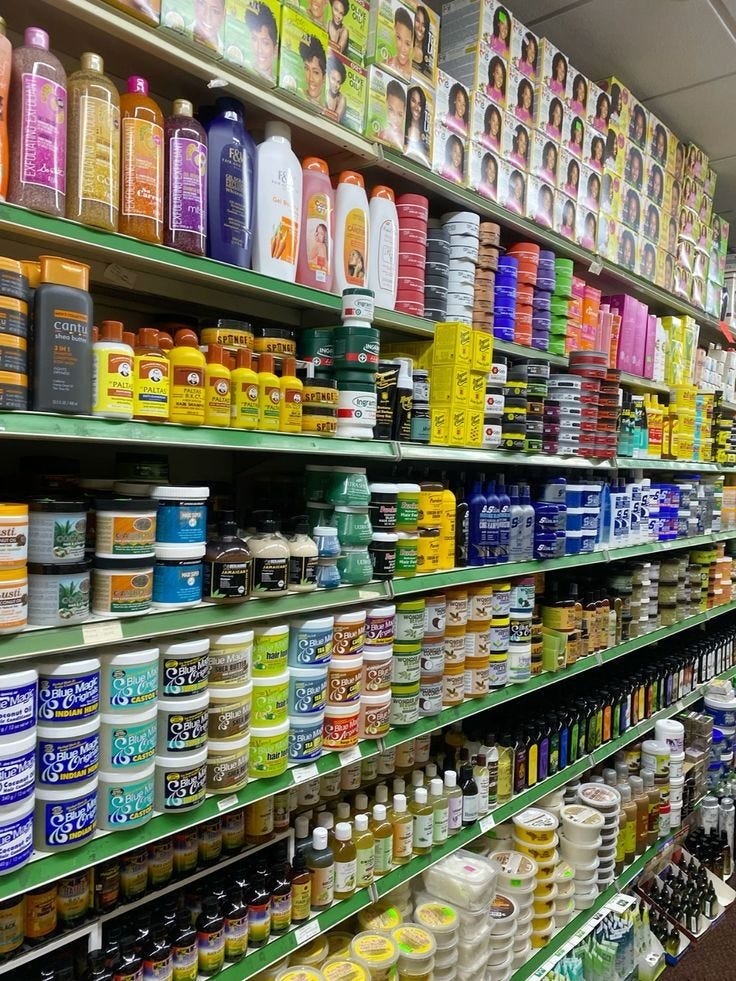
Textured hair has its own set of structural characteristics that influence how we care for it. Its curl pattern and points of curvature can make it more susceptible to tangling, dryness and breakage, particularly when it is manipulated frequently. That means the market has understandably responded with products claiming to address everything from breakage and frizz to length retention and scalp concerns. But this is where I start to question the relationship between what catches our eye and what actually delivers results. Are we choosing products because the packaging and marketing have convinced us they are the answer, or because we genuinely understand what our hair needs?
As technology advances, so does everything else — haircare included. What’s interesting to me is that, as much as marketing plays a significant role in influencing us to spend, we, the consumers, have more impact on the direction that trends are followed. Social media continues to influence the choices we make towards beauty today, and it’s also used as a collective voice to spread awareness, knowledge and education across the social sphere.
For many of us, YouTube was that girl! Influencers such as Jackie Aina, Aaliyah Jay and Alissa Ashleywould only have to mention a product and the makeup girlies would run to buy anything they mentioned. As apps like TikTok became more popular, regular people like me and you had the same amount of reach as major influencers, changing the way social media was consumed. Big brands were no longer solely in charge of trends; increasingly, they were responding to what we, the consumers, were getting into.
As our economic climate changes and things become more expensive, I think our relationship with beauty products is changing too. We’re becoming more conscious of where our money goes and, perhaps more importantly, what we’re actually getting in return for it. We’ve seen this shift happen in skincare over the last few years. I’ve experienced it personally through incorporating Korean skincare into my own routine, but as a former Buying Assistant, I’ve also seen retailers create more space for these brands and the conversations surrounding them.
However you feel about K-Beauty, I don’t think the appeal is just the sleek, chic packaging. A huge part of the attraction is knowing what you’re buying, why it’s there and what it’s supposed to do. We’ve started to care about real ingredients and real results, and I think that growing curiosity is beginning to influence the way we think about haircare too.
Throughout my life, I’ve suffered with issues such as dry scalp and breakage and, trust me, I’ve tried every product under the sun. When I was younger, my mum didn’t necessarily know what would work either, so she did what many of us have seen at home: she experimented with what she had available. At one point, she mixed my Sulphur 8 hair pomade with a steroid cream for my eczema, which eventually seemed to do the trick!
Looking back, I don’t think this was simply a case of using the “wrong” product. We were trying to solve a genuine problem with the information we had. And this is where I think the real gap exists: there is no shortage of products, but there is still a shortage of accessible education about what those products are for, how to use them and what the ingredients are supposed to do.
We see it all the time. Brands make big claims to entice us into buying their products, and what you can end up with is a vicious cycle: purchasing, using, not seeing the results, buying something else and, before you know it, keeping the money out of your pocket and putting it into the pockets of huge corporations. But this power shift has inadvertently changed who gets to shape the conversation. We can now question brands more openly, challenge misleading claims, test products and share our own experiences with other consumers. Increasingly, we can also work with brands to promote products because we actually use them ourselves.
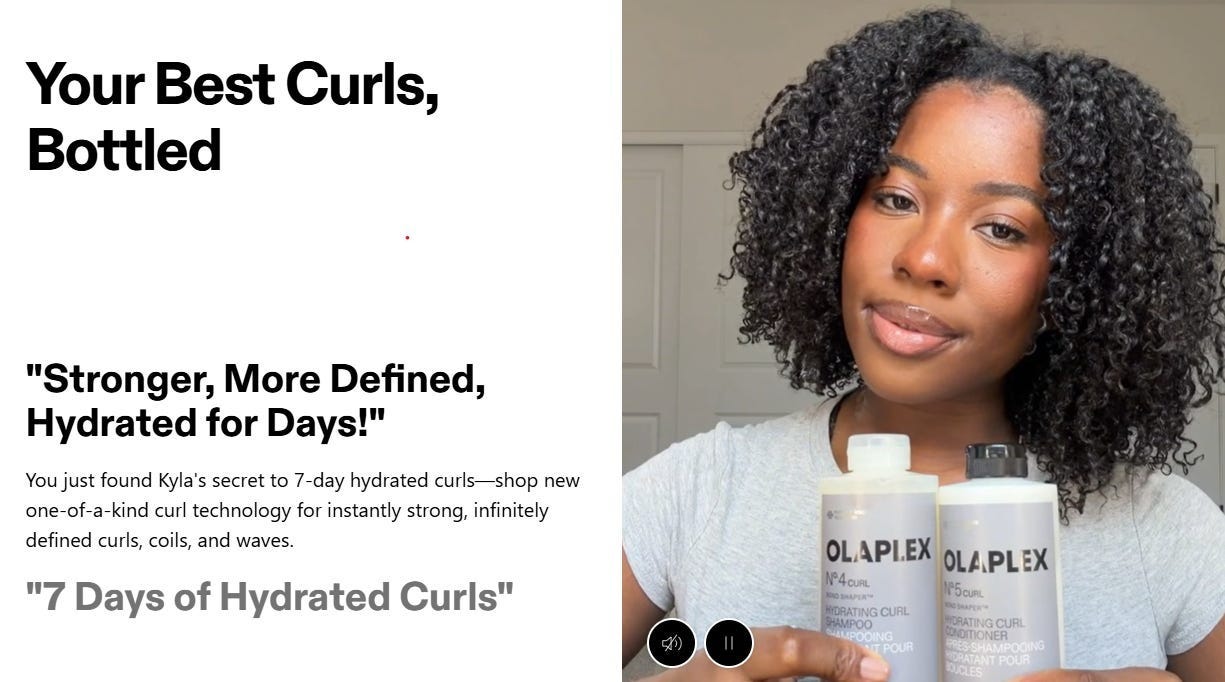
Representation plays a huge factor in this observation too. Social media has not only created space for a more personable voice to be heard, but its use of UGC creators in advertising has boosted this even further. Growing up, it was rare to see someone with textured hair featured in a mainstream beauty campaign unless the product had specifically been designed towards Black women. There was no way you were going to see a Head & Shoulders advert with a Black girl with an afro on the television — it just wasn’t going to happen.
That didn’t mean Head & Shoulders wouldn’t work for us. But how is it possible to know whether it does if the only people you consistently see using it have straight hair? Immediately, you subconsciously categorise those kinds of brands with a certain type of hair and naturally go looking for something that feels tailored to you.
That’s why I think representation is about more than visibility. Lack of representation materially affected our ability to evaluate whether a product was intended for us. The industry didn’t suddenly discover that Black women buy haircare. It discovered that Black women were already buying it — and now better representation is making it easier for us to see where we fit within the wider market.
This is also why I lean strongly towards education being the key to a happy pocket and a healthy head of hair. Unless you had the privilege of knowing your hair from a young age, or were introduced to the salon way of life, treating textured hair could feel like Groundhog Day — years of manipulation and a lack of education around how to properly care for our hair can leave us repeatedly buying, trying and starting again.
I think it’s important to recognise that naturally textured hair has its complexities. It’s curly, it tangles easily and can be prone to breakage, so it’s crucial to find styles that suit your personal capacity for maintenance. I often wonder how different the Black experience would be if our hair wasn’t tied to this socio-political history. Wearing your natural hair can feel like something you have to grow into, finding a way to almost introduce yourself to a world that is often telling us that it’s not acceptable. What a freeing feeling it would be to just wear your hair however you wanted — and I feel that a lot of us have started to do this.
Everyone will have a different idea about what is considered “budget-conscious” when it comes to haircare, and this is exactly why this conversation is needed. Being cheap isn’t always the same thing as being economical. I personally would much rather invest in a routine that genuinely works for my hair within my budget, than continuously buy inexpensive products that don’t address what I need, only for those purchases to accumulate over time.
Sometimes, the cheaper option is costing us more.
The interesting point is that investing in your hair will look completely different depending on who you are. For the DIY girlies, that investment might be learning how to braid your own hair, trim your ends, or buying a steamer or heat cap that makes your deep-conditioning routine more effective at home. For someone else, it might mean paying for a professional appointment once a month because they simply don’t have the time, patience or desire to do their own hair. Neither approach is better. The real luxury is knowing what works for you and where your money is best spent.
Something I’ve noticed recently is the major shift a lot of us are making towards higher-end brands such as Redken, K18 and Olaplex. Yes, these brands are bringing more science-led formulations into the conversation, but I think the education and representation improving over time are also playing a key role in making them feel relevant to us. When we see women who represent us using these products, demonstrating how they work and what they can do, the gap between “this isn’t for me” and “this can work for my hair” becomes much smaller. It’s not rocket science; we respond to what we can see, understand and relate to.
And this is the main reason why I don’t see natural haircare and science-led haircare as opposing sides of some imaginary beauty war. They can work together exceptionally well, building your very own personalised hair regimen. Investing in an advanced shampoo or treatment for one part of your routine and still reaching for an affordable product from your local beauty shop for another is my kind of routine. There are just some products I love bouncing between.
The goal isn’t to build the most expensive routine possible. The goal doesn’t have to be using the cheapest products available either. It’s to develop an understanding of what each product is doing, what your hair truly needs and where an investment will genuinely make a difference.
The CURLNOISE. Edit: Investing in Expertise
Mastering your hair isn’t a journey you have to take entirely alone. Sometimes, the best investment you can make isn’t another product, but paying someone who can actually help you understand what your hair needs. If you’re ready to step out of the trial-and-error cycle and build a more tailored routine, finding the right professional can be worth far more than simply paying for a hairstyle.
For those looking for a more education-led approach to Afro and textured haircare, Hair Lounge by Charlotte Mensah on Portobello Road offers a full-service experience built around cleansing, conditioning and finishing, alongside treatments such as Manketti Oil and protein treatments. Their approach is a useful reminder that professional haircare doesn’t have to stop at the finished look — understanding how your hair is being cared for underneath it matters too.
For those wanting to better understand their curls and coils, The Curl Bar London offers curl styling and education, curl-by-curl cuts, steam and treatment services, with its team placing a clear emphasis on helping clients embrace and understand their natural texture. That education can be just as valuable as the service itself; learning how your hair behaves can make what happens at home feel far less like guesswork.
And sometimes, the most valuable thing you can invest in is a proper consultation. For highly individualised advice, expert Subrina Kidd at The Collective is another name worth exploring for anyone looking to build a routine around their own hair rather than simply following whatever is trending online.
The point isn’t that everyone needs to be booking luxury appointments every month. It’s that professional expertise can give you something a product never can: a better understanding of your own hair. And when that knowledge helps you maintain more of your routine at home, the investment can continue paying you back long after the appointment is over.
Ruka is another interesting example of what happens when innovation starts with the realities of textured hair. The UK brand has continued to rethink protective styling through its Braid-it Synths® 2 range, using collagen protein fibre in place of conventional plastic-based synthetic fibre and offering different textures to suit the way consumers actually wear their hair.
For me, that is where the future of textured haircare gets exciting. We don’t need to choose between what is familiar and what is innovative, or between the salon and the beauty shop. We need more solutions that help us understand our hair, care for it properly and make decisions that actually fit our lives.
Because investing in your hair should never simply mean spending more. It should mean spending with purpose.
Changing the Frequency: The New Rules of Curls
Falling into the curly, coily and kinky hair bracket comes with its own learning curve. Our hair is tied so deeply to identity, heritage and culture, but true understanding starts when we accept that texture is personal. There is no one-size-fits-all blueprint. A routine or product that works miracles for someone else might completely fail for you — and that’s okay.
Whatever hairstyle you choose to rock, the goal should be to do it from a place of knowledge and confidence. Whether you’re wearing a pixie cut, a sew-in or intricate Fulani braids, the relationship you have with your hair in between those styles matters too. The same energy, capital and concern we willingly invest in maintaining our protective styles deserves to be invested in understanding our natural hair. What does it actually like? What environments influence the choices we make? And how do we genuinely want to show up in the world?
Healthy hair does not have a singular look. There is no direct correlation between waist-length hair and optimal health, and the goal shouldn’t be to chase someone else’s version of it. At the same time, we cannot remain naïve to the amount of noise surrounding us. Through social media, community trial and error and emerging technologies, we have more access to information than ever before — but more information does not always mean more understanding.
That is why I keep coming back to the same idea: understanding has become the ultimate beauty luxury. The modern consumer has more power to question claims, investigate ingredients, learn from others and decide what actually works for them. In a market flooded with digital noise, knowledge is what allows us to filter it.
And perhaps that is the real shift we need to make. Surviving the chaos of the modern beauty market isn’t about choosing between traditional haircare and science-led innovation. It’s about knowing enough to use both intelligently. It’s about knowing when to invest, when to save, when to ask a professional for help and when you’ve already got what you need sitting in your bathroom cabinet.
It is time to let go of the pressure to do it all perfectly. You do not owe anyone a twelve-step Sunday routine, and your hair health shouldn’t feel like a second job. Once you understand what your hair needs, you gain something far more valuable than another product recommendation: the freedom to wear your hair however you want, in a way that fits your lifestyle, your wallet and your terms.
True luxury isn’t about buying another product; it’s about having the clarity to know what works for you. We are changing the frequency of how we look after our curls, putting ourselves firmly back in the driver’s seat. The latest viral product will come and go, but knowing your hair will always be worth investing in.
The CURLNOISE. Discourse:
The guesswork stops here. Has the constant influx of social media trends made you feel overwhelmed with your hair routine lately? What is one product switch or budget hack that has actually saved your wallet this year? Drop your thoughts in the comments below — let’s chat!

If you are interested in becoming a GUAP contributor and telling stories that matter to the culture we want to hear from you. We commission emerging writers, journalists and video creators every month to cover the people, communities and moments our audience needs to discover. Your subject. Your voice. No brief.
For more information/submit a story - click here.

Consider becoming a paid subscriber and gain access to:
The full GUAP Daily: five deep-dive articles/video essays written by and for the culture, a week straight to your inbox, Monday to Friday.
The Sunday opportunities newsletter - jobs, freelance roles, commissions, casting calls and industry openings every week
Monthly online events - masterclasses, workshops, live interviews and community gatherings ran by OURPPLS.
Discounts/Perks from our community partners including Tunecore,
For only £6 a month (price of a coffee) you get access to the opportunities, the knowledge and the community that keeps you close to the culture. Whether you are building something or you just care about what is happening - this is where you want to be. And every membership puts money directly into the hands of the writers and creators telling the stories that actually matter.